Apples, Atoms and Algorithms Romania and Kazakhstan in a New Historical Cycle

The only Romanian who has ever travelled beyond our planet began his “star trek” on Kazakh soil. On 14 May 1981, Dumitru-Dorin Prunariu lifted off from the Baikonur Cosmodrome aboard Soyuz 40, becoming Romania’s first – and so far only – cosmonaut. There is something almost irresistibly symbolic about this episode in the history of Romanian–Kazakh relations: before our countries had developed the economic connections that would later bring them closer together, they had already shared a launching pad. More than four decades later, the metaphor remains tempting. We have the launch pad; what we still need is a flight plan. The occasion for revisiting this relationship was a round table held in Bucharest on 17 November 2026, with the support of the Embassy of the Republic of Kazakhstan in Romania, devoted to the country’s priorities in what President Kassym-Jomart Tokayev has called a new historical cycle. The expression deserves both attention and a little caution. Romanians have experienced enough historical cycles to know that history does not always return bearing gifts. As Mihai Eminescu observed, “all is old, and all is new” [“toate-s vechi și nouă toate” – Glossă (1883)]. The Silk Road is old; the fibre-optic infrastructure now spanning the Caspian is new. The geography remains remarkably familiar, even as the technologies, institutions and economic incentives that give it meaning continue to change. Kazakhstan’s thirty-fifth anniversary of independence, accompanied by a new constitutional architecture and an ambitious programme of economic modernisation, offers an appropriate moment for reflection. Yet the essential question is not whether another historical cycle has begun, but whether the societies involved can turn geographical circumstances, inherited connections and technological possibilities into genuine opportunities for cooperation. History may provide the setting, but it does not write the script.
Romania and Kazakhstan are, in fact, closer than their positions on the map might suggest. The relationship begins, unexpectedly, with something as ordinary as an apple. The wild ancestor of the domestic apple, Malus sieversii, still grows in the foothills of the Tian Shan, near Almaty, whose name itself recalls the fruit. Every apple in a Romanian orchard may thus be said to have a Kazakh great-grandmother – a botanical exaggeration, perhaps, but one with respectable evolutionary credentials. The historical connections are no less intriguing. The Kipchaks, known in Romanian chronicles as Cumans, travelled across the Eurasian steppe towards the Danube, leaving traces in the region’s toponymy and, according to a longstanding scholarly hypothesis (and controvery), possibly even in the name of the Basarab dynasty. Teleorman, traditionally associated with a Cuman expression meaning wild forest, offers one such linguistic reminder. Yet the more substantial contemporary links are measured not in etymologies, but in energy flows and capital. Kazakhstan accounted for 39% of global uranium mining in 2024, while international trade statistics record approximately 473 tonnes of natural uranium and related compounds exported from Kazakhstan to Romania that year. These figures are consistent with Kazakh official accounts of deliveries associated with the Cernavodă nuclear power plant, although the precise industrial use of the material should not be inferred from customs statistics alone. Oil provides an even more visible connection. Kazakhstan’s KazMunayGas acquired control of the Rompetrol group in 2007, including the Petromidia refinery on Romania’s Black Sea coast, establishing one of Kazakhstan’s most significant corporate presences in Europe. What emerges is an unusual geography of economic interdependence: from the Central Asian steppe to the Black Sea, from natural resources to industrial processing, from distant historical encounters to contemporary investment decisions. Geography separates our countries by thousands of kilometres; economic exchange has found ways to shorten the distance.
This concentration of economic relationships emerges clearly from the collective research undertaken at the Bucharest University of Economic Studies, within the Faculty of International Business and Economics, for the (forthcoming) 2026 volume Romania’s Economic Relations with Asian Partners. The study approaches Asia not as a homogeneous economic space, but as a constellation of Asias – regions, economies and institutional arrangements whose relationships with Romania differ considerably. Kazakhstan appears across several dimensions of this analysis, particularly trade, investment and transport connectivity. According to the study’s findings, Kazakhstan was already among Romania’s leading Asian suppliers in the mid-2000s and had become, by 2024, a particularly important source of mineral fuels. Kazakh official statistics place bilateral merchandise trade at approximately US$2.92 billion in 2024, overwhelmingly concentrated in petroleum, which accounted for around 97% of the reported total. The same statistics reveal a pronounced asymmetry between Kazakh exports to Romania and Romanian exports in the opposite direction. Such an imbalance should not automatically be interpreted as an economic pathology requiring political correction: international trade is not a contest in which every bilateral account must balance, nor does a country become poorer merely because it imports more from one partner than it exports to that partner. Nevertheless, the figures reveal limited commercial diversification and considerable scope for Romanian businesses to discover a market whose importance has so far been perceived mainly through energy supplies. Investment relationships, including the more recent emergence of Kazakh portfolio capital in Romania documented by the study, suggest that bilateral economic connections extend beyond merchandise flows, even if their statistical interpretation requires caution. The relationship is therefore deeper than a casual reading of trade figures might suggest, but narrower than its potential would justify. To borrow an image from the sector that currently dominates it, Romanian–Kazakh economic cooperation resembles a pipeline more than a network. Pipelines are valuable, particularly when they deliver essential resources. Networks, however, offer something more: diversification, resilience and the possibility of connections that no single participant can fully anticipate or centrally design.
Kazakhstan’s recently articulated development priorities invite precisely such a transition. President Tokayev’s address of 28 October 2026 placed particular emphasis on infrastructure construction, transport connectivity, energy security, industrial diversification and digital transformation, alongside reforms intended to improve investment conditions and the functioning of public institutions. These ambitions deserve to be read not merely as a national development programme, but also in the wider context of Eurasia’s changing economic geography. Kazakhstan already occupies a pivotal position in overland trade between China and Europe, while the development of the Trans-Caspian International Transport Route, commonly known as the Middle Corridor, could strengthen this position and offer European economies additional commercial options. Among the projects highlighted in the presidential address were the Bakhty–Ayagoz railway, expected to enter service in 2027, and the Aral–Caspian corridor, intended to shorten transport distances and delivery times. These are projected benefits, naturally, not accomplished economic outcomes. Romania, through the Port of Constanța and its connections to Central and Eastern Europe, has an obvious interest in such developments. Yet a transport corridor is only as efficient as its slowest border crossing, its most congested port or its least reliable railway section. Geography may suggest an opportunity, infrastructure determines whether it can be exploited, and institutions ultimately determine whether it becomes sustainable. The same logic applies to energy and digital connectivity. Kazakhstan’s uranium resources, Romania’s nuclear operating experience, the emerging Caspian fibre-optic infrastructure and prospective Black Sea electricity connections suggest a Eurasian corridor capable of carrying not only containers and hydrocarbons, but also electrons, information and expertise. These possibilities are promising, though hardly self-executing. A memorandum does not move a train, a strategic declaration does not generate electricity, and an ambitious digitalisation programme does not automatically produce a competitive digital economy. The invisible infrastructure of contractual certainty, predictable regulation, property rights and enforceable commitments remains indispensable. Hayek would surely have appreciated the paradox: the finest physical infrastructure can be rendered economically unproductive by the absence of reliable institutional rules.
What, then, might a more diversified Romanian–Kazakh partnership look like? Its development need not depend upon spectacular diplomatic announcements or grandiose investment schemes. Three relatively modest directions deserve attention. The first is the expansion of non-energy trade, particularly in agri-food products, wood and furniture, pharmaceuticals, engineering and information technology services. Kazakh diplomatic representatives have identified several hundred million dollars in potential additional bilateral commerce, an estimate best understood as an indication of opportunities to be explored rather than an outcome awaiting automatic realisation. The appropriate response to the existing trade imbalance is not to restrict imports, but to make it easier for competitive Romanian producers to reach Kazakh consumers and businesses. The second direction concerns logistics: a more structured relationship between the Caspian ports of Aktau and Kuryk and Romania’s Constanța, supported by improved customs procedures, digital documentation and better coordination between maritime and railway operators. The third is a knowledge corridor connecting universities, research institutions and businesses. Joint research projects, student and academic mobility, comparative studies of Eurasian connectivity and regularly updated economic data could help transform occasional encounters into lasting cooperation. Universities may be among the least expensive embassies, but their contribution is not measured by diplomatic ceremony. They create relationships of trust, generate knowledge that can challenge official optimism and train people capable of identifying opportunities beyond the priorities established by governments. In this respect, Romania’s Euro-Atlantic institutional anchoring and Kazakhstan’s multi-vector foreign policy need not be viewed as competing geopolitical identities. They are different responses to a common problem: how to participate in an interconnected world without becoming excessively dependent on any single partner. The Middle Corridor, from this perspective, is less a geopolitical weapon than an economic insurance policy. Its greatest value lies in expanding choice, not replacing one exclusive dependency with another.
There is an older Eurasian story that offers a fitting conclusion. In 1218, at Otrar, on the Syr Darya in present-day Kazakhstan, a caravan of merchants sent by Genghis Khan into the Khwarazmian realm was seized, its goods confiscated and its members killed on the orders of the local governor. The subsequent refusal to provide adequate redress, compounded by the mistreatment of Mongol envoys, contributed decisively to the outbreak of the Mongol invasion of the Khwarazmian Empire in 1219. The consequences of Mongol expansion would eventually reach the Carpathian region in 1241. Otrar may thus be remembered, with a certain grim economic irony, as the setting of one of history’s costliest breakdowns in commercial trust – although the catastrophe that followed cannot, of course, be reduced to a single trade dispute. Yet Otrar, historically associated with Farab, evokes another and radically different legacy: that of Al-Farabi, the philosopher celebrated in the medieval Islamic intellectual world as the Second Teacher, after Aristotle. Traditionally linked to the Farab region, his intellectual work helped interpret and transmit elements of Greek philosophy across cultural and linguistic boundaries, contributing to a much wider history of knowledge circulation. The same geographical setting thus evokes two profoundly different possibilities: the destruction of exchange through coercion and the enrichment of societies through the movement of ideas. Between these legacies lies a lesson extending well beyond Romanian–Kazakh relations. Economic development is not simply the accumulation of resources, infrastructure or technological capabilities. It is also the creation of conditions under which people, goods, capital and ideas can move voluntarily, predictably and productively. Historical cycles may be proclaimed by presidents, commemorated by diplomats and analysed by scholars, but their ultimate value depends on the freedom and ingenuity of those who live through them. If a new Romanian–Kazakh chapter is indeed beginning, one might hope that it will be written less in the spirit of Otrar in 1218 and more in that of Al-Farabi. From the orchards of Almaty to the launch pad of Baikonur, from the energy infrastructure of the Black Sea to the digital corridors of tomorrow, the odyssey is long, but the orientation is worth pursuing.
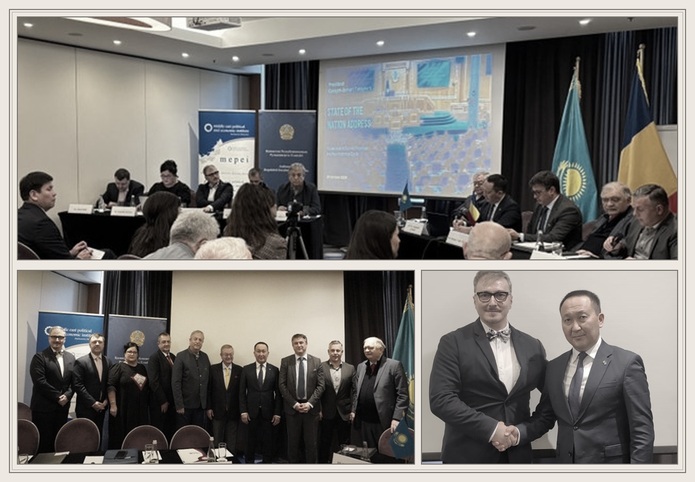
Editorial Note. This essay draws on remarks delivered by the author at the round table “Kazakhstan’s Current Priorities in a New Historical Cycle”, held on 17 November 2026 at the Sheraton Bucharest Hotel. Organised by the Middle East Political and Economic Institute (MEPEI), in partnership with EuroDefense Romania and the Strategic Dialogue for Global Affairs Initiative (SDGAi), with the support of the Embassy of the Republic of Kazakhstan in Romania, the event brought together representatives of diplomacy, academia, business, research and strategic affairs to discuss Kazakhstan’s evolving development priorities and their implications for regional and international cooperation. The proceedings opened with an address by H.E. Amangeldy Sainov, Ambassador of Kazakhstan to Romania, and were moderated by Dr. Flavius Caba-Maria, President of MEPEI. The panel featured Liviu Mureșan (EuroDefense Romania), Iuliu Stocklosa (Bucharest Chamber of Commerce and Industry), Emil Rapcea (former Romanian Ambassador to Kazakhstan), Corneliu Vișoianu (UMP Plopeni), Ecaterina Mațoi (SDGAi), Octavian-Dragomir Jora (Bucharest University of Economic Studies), Iulian Mareș (MEPEI) and Mihai Sebe (European Institute of Romania). The present article revisits and develops the economic arguments advanced on that occasion, placing Romanian–Kazakh relations within the broader historical, institutional and geopolitical transformations of Eurasia.