Energy Security and the Green Transition in Central Europe: Between Necessity and Resistance Policy Brief, 2026 Series: “Romania at a Crossroads” – Episode 6

Romania’s energy security and green transition have become increasingly interdependent, shaped by both regional geopolitical pressures and the obligations of EU climate policy. While Romania benefits from low energy-import dependency and a structurally resilient electricity mix dominated by natural gas, nuclear, and hydropower, its progress in renewable energy deployment has been slow. Drawing on Eurostat, ENTSO-E, EC Climate Monitoring Reports, and national energy-planning documents, this article blends security analysis with transition governance to evaluate Romania’s energy system between 2015 and 2025. The findings show a country well-positioned for resilience, but institutionally slow to transition, with grid constraints, weak permitting systems, and regulatory inconsistency acting as major barriers. The discussion interprets these dynamics through regional comparisons and EU conditionality, proposing strategic pathways for Romania’s 2030 energy future.
Introduction – at the intersection of security and transition
Romania sits at the intersection of two powerful forces reshaping Europe’s energy landscape, and this dual advantage – security resilience from domestic resources and reduced import exposure – creates both opportunities for strategic leadership and risks of political complacency. On one hand, the Russian invasion of Ukraine in 2022 transformed energy security from a long‑term priority into an immediate strategic imperative (European Commission, 2024; IEA, 2023). On the other hand, EU climate policy – anchored in the European Green Deal and the Fit‑for‑55 package – demands rapid decarbonisation and deep structural reform (European Commission, 2023). Romania’s long‑standing advantage of low import‑dependency, supported by domestic gas production, hydropower, and a stable nuclear base, has insulated the country from much of Europe’s energy shock (Eurostat, 2024). Yet this resilience has complicated the country’s green transition, reinforcing a political narrative that Romania has “more time” than other member states.
This duality mirrors broader trends across Central Europe and sets the stage for the central argument of this analysis: Romania’s energy resilience provides short‑term stability, but its institutional inertia slows the structural changes required for long‑term competitiveness., where states such as Poland, Hungary, and Czechia have struggled to balance energy security with transition obligations (OECD, 2024). While Romania leads several regional peers in maintaining a diversified energy mix, it lags behind EU frontrunners in renewable integration, grid modernisation, and the phase‑out of fossil‑based generation. These tensions increasingly shape the national energy debate, which now revolves not only around technical feasibility, but also political resistance, affordability concerns, and public acceptance. The national discussion increasingly hinges on the intersection of technical feasibility, political resistance, affordability concerns, and public acceptance.
Methods
This analysis adopts a mixed-methods approach, combining quantitative review of official datasets with qualitative interpretation of energy-policy documents. Eurostat’s energy-balance and import-dependency indicators provide the empirical foundation for long-term trend assessment. ENTSO-E supply, demand, and interconnection data offer insight into electricity generation and grid performance, while EC Climate Action Monitoring Reports provide benchmarks for measuring Romania’s progress against EU climate goals. National datasets, including the Romanian National Energy and Climate Plan (NECP), Transelectrica’s annual grid reports, and government energy strategies, support the analysis with national-level detail.
Indicators reviewed include key trends in Romania’s energy mix between 2015 and 2025, electricity‑generation patterns, and import‑dependency rates. Additional variables – such as investment flows in nuclear and offshore gas, renewable‑energy integration, and the degree of grid congestion and interconnection capacity – provide further insight into structural constraints. These variables form the basis for a coherent assessment of Romania’s progress and structural constraints.
Comparative benchmarks are drawn from Poland, Hungary, and Bulgaria to situate Romania within a broader Central European context.
Results
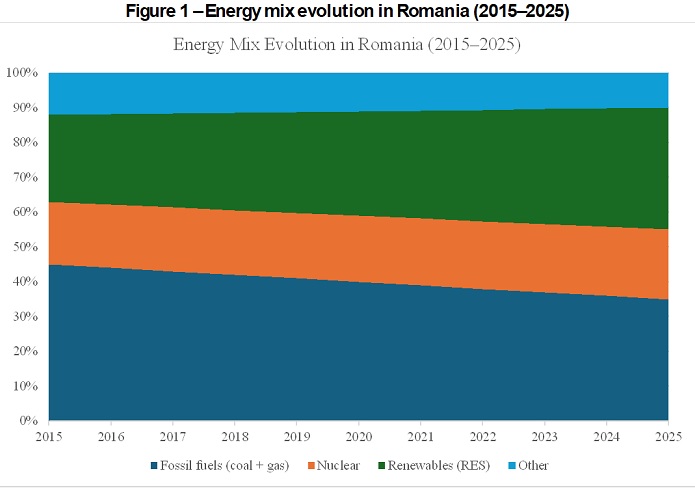
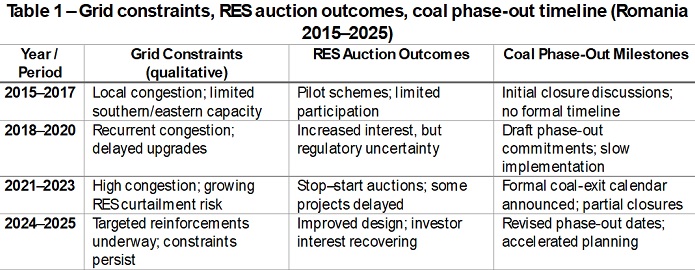
Romania’s energy system remains structurally resilient, shaped by a diverse generation profile and a comparatively strong domestic production base. Natural gas, hydro, and nuclear power continue to dominate electricity generation, while coal has declined significantly – from over 20% in 2015 to low single digits by 2025. Renewable energy capacity, particularly solar PV, has expanded, but integration remains limited due to grid congestion and slow permitting. Romania’s energy-import dependency continues to rank among the lowest in the EU, supported by domestic gas production and plans for the Neptun Deep offshore project.
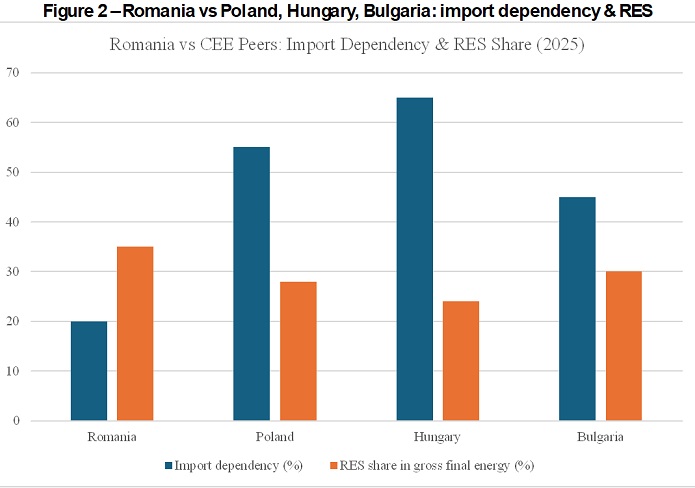
Romania performs favourably in terms of energy security relative to Central European peers, but lags in renewable deployment. Poland and Czechia are accelerating coal phase-out, while Hungary’s regulatory barriers constrain new RES installations. Bulgaria displays moderate renewable progress, but remains reliant on lignite. Romania, although more balanced, shows slower-than-required growth in wind and solar capacity.
Grid constraints form a recurring barrier, with Transelectrica reporting persistent overloading in southern and eastern corridors and insufficient interconnection progress. Romania’s auction-based RES support schemes have produced mixed outcomes, with investor interest fluctuating amid regulatory shifts.
Discussion
Romania’s energy trajectory reveals a direct link between institutional delays – particularly in grid expansion and permitting – and concrete policy consequences such as stalled renewable integration, higher system‑balancing costs, and reduced investor confidence, a country positioned between structural resilience and institutional hesitation (IEA, 2024). While domestic production, hydropower stability, and nuclear generation reduce external vulnerability, this security cushion has contributed to a slower strategic pivot toward full decarbonisation. Because Romania is perceived as “less exposed” than neighbours such as Poland or Hungary, political actors have repeatedly deferred disruptive reforms.
These institutional pressures intersect with a rapidly evolving geopolitical environment, intensifying the need for coherent planning. The Black Sea has become a contested maritime and energy corridor, shaped by Russia’s posture and hybrid disruptions (Black Sea Strategic Energy Forum, 2024). Potential offshore wind zones, future gas pipelines, and submarine electricity connections all exist in a security environment where infrastructure protection and maritime awareness carry increasing weight.
European policy adds additional pressure for alignment. The Fit‑for‑55 package imposes binding emissions‑reduction trajectories across sectors, while NECP revisions underline gaps between planned renewable additions and real grid‑integration capacity (European Commission, 2024). Progress remains uneven. Permitting bottlenecks, slow grid‑extension projects, and fluctuating investor confidence – all documented in Transelectrica’s annual reports – signal the absence of a predictable long‑term investment environment.
Affordability concerns play a significant role in shaping political resistance. The legacy of volatile energy prices since 2022, combined with Romania’s political sensitivity to household energy costs, fuels public anxiety and strengthens narratives suggesting that renewables and EU climate policy drive higher bills or threaten industrial competitiveness. These perceptions echo patterns seen in Czechia and Slovakia, where affordability fears shape electoral rhetoric and delay transition measures. At the local level, procedural complexity, land‑use conflicts, and limited awareness further constrain acceptance, while political actors with vested interests in conventional assets often frame renewables as externally imposed obligations. Resistance in Romania is thus driven less by ideological opposition and more by accumulated mistrust in policy stability, distributional concerns, and the political incentives tied to maintaining the status quo. Energy‑price volatility since 2022 fuelled public anxiety, creating fertile ground for narratives framing decarbonisation as a driver of higher household costs and industrial decline. Such narratives, also visible in parts of the Czech and Slovak political space, slow reform momentum and require proactive government communication to counter misinformation. A transparent articulation of both the short‑term costs and long‑term benefits of transition – economic competitiveness, reduced price volatility, and enhanced strategic autonomy – is critical.
At the same time, Romania’s grid limitations represent a structural constraint that cannot be solved through political messaging alone. Transelectrica’s reports consistently highlight congestion in southern and eastern corridors, delays in upgrading substations, and limited interconnection capacity with neighbouring markets (Transelectrica, 2024). These constraints directly impede renewable deployment and restrict Romania’s participation in regional balancing markets. Without accelerated investment in transmission infrastructure, the country’s renewable‑integration targets will remain aspirational.
Regionally, Romania occupies an intermediate position. Compared with Poland, which is aggressively accelerating coal phase‑out, offshore wind planning, and RES auctions, Romania’s diversification advantage is offset by slower grid and permitting reforms. Poland’s coordinated offshore wind, and nuclear strategy gives it a clearer long‑term path, albeit from a more carbon‑intensive baseline. Hungary, by contrast, has scaled solar rapidly – now among the highest per capita in the EU – and pairs it with heavy reliance on nuclear power, yet remains geopolitically exposed and dependent on imports during system stress. Bulgaria, still lignite‑reliant, but moderately expanding RES and interconnectors, mirrors part of Romania’s structural inertia, but with fewer diversification options. In this spectrum, Romania sits between security‑based resilience and transition‑based hesitation: more secure than its peers, yet slower than frontrunners in turning potential into accelerated renewable deployment. It is more secure than Poland or Hungary due to domestic production, but lags behind countries like Croatia or Greece, which have accelerated offshore wind planning and interconnector development. Romania’s long-term potential – particularly for offshore wind and advanced nuclear – depends on aligning its investment priorities with EU taxonomy, accessing Innovation Fund financing, and maintaining stable regulatory frameworks that attract private capital.
EU conditionality increasingly serves as a backbone for reform, reinforcing the empirical patterns identified earlier and providing Romania with both obligations and opportunities to correct structural weaknesses. The revised NECP, together with Fit‑for‑55 obligations, is pushing Romania toward clearer commitments on renewable deployment, coal exit, and energy‑efficiency measures. Yet implementation gaps persist, largely due to fragmented governance, variable ministerial leadership, and insufficient cross-sector coordination.
To accelerate renewable deployment by 2030, Romania must pursue a sequenced strategy centred on grid reinforcement, streamlined permitting, predictable support schemes, and broader citizen and industrial participation. Grid‑first investment – particularly in southern and eastern corridors – would unlock hosting capacity for new solar and wind, while a one‑stop permitting framework with clear time limits would reduce delays. Predictable auctions and corporate PPAs can improve bankability, and expanding prosumer schemes and energy communities would widen social participation. These measures must operate alongside industrial decarbonisation pathways, including electrification, storage, and green‑tech deployment, so that the transition supports competitiveness rather than constraining it.
Overall, Romania’s challenge is not the absence of strategic options, but the lack of integrated governance capable of aligning its security advantages with its transition responsibilities. Energy security and decarbonisation cannot remain parallel tracks. They must converge through a coherent, well-sequenced, and politically credible strategy.
Conclusion / policy directions
Romania’s long‑term energy strategy requires a deliberate alignment with the empirical findings presented above, ensuring that its recommendations directly address documented grid constraints, permitting delays, and investment gaps, a deliberate convergence between security imperatives and transition commitments. While domestic gas production, hydropower stability, and nuclear generation currently underpin national resilience, these assets must be integrated into a forward‑looking decarbonisation pathway that aligns with EU climate goals and future competitiveness. Ensuring this alignment will depend on stable political leadership, predictable regulation, and a nationally coherent vision for the 2030 and 2050 milestones.
A strengthened 2030 outlook demands accelerated investment in transmission and distribution infrastructure and must be understood as a direct response to the empirical bottlenecks documented in this analysis. These upgrades are essential for accommodating the anticipated growth in variable renewable generation, particularly solar and onshore wind, and for supporting the emergence of offshore wind as a strategic Black Sea asset. in transmission and distribution infrastructure, including the reinforcement of overburdened southern and eastern corridors and the expansion of interconnection capacity with neighbouring states. These upgrades are essential for accommodating the anticipated growth in variable renewable generation, particularly solar and onshore wind, and for supporting the emergence of offshore wind as a strategic Black Sea asset. Grid modernisation must be matched with a coherent permitting reform that reduces delays and builds investor confidence. Without these enabling conditions, Romania risks remaining structurally constrained regardless of its natural resource potential.
The industrial transformation required by Fit‑for‑55 and the EU Green Deal will intensify by 2030. Energy‑intensive sectors – metals, chemicals, cement, and automotive – will need credible transition plans, supported by targeted government incentives, Innovation Fund resources, and access to affordable green electricity. Romania can leverage its nuclear and gas assets as transition stabilisers, but only if these are embedded within a broader strategy to stimulate clean‑tech investment, electrification, and the expansion of flexibility resources such as storage, DSM mechanisms, and regional balancing markets.
Looking beyond 2030, Romania’s 2050 trajectory will hinge on whether the country can successfully resolve the structural constraints identified throughout this article – grid congestion, slow permitting, fragmented governance, and uneven investment signals – so that future technologies such as offshore wind and advanced nuclear can operate as intended. on whether the country succeeds in integrating offshore wind, advanced nuclear technologies (including potential SMR deployment), and expanded regional interconnections. By this stage, energy security and climate obligations will no longer be viewed as competing priorities, but as mutually reinforcing components of a resilient, decarbonised energy system. Long‑term competitiveness will depend on Romania’s ability to cultivate a regulatory environment capable of sustaining large‑scale investment, while simultaneously protecting critical infrastructure in an increasingly complex Black Sea security environment.
Public acceptance will remain a decisive factor throughout this transition. Romania must proactively communicate the economic and security benefits of the green transition, counteract misinformation, and ensure that vulnerable households are supported through incremental tariff reforms and targeted social measures. A just and transparent transition narrative is essential for maintaining political stability and preventing resistance from undermining long‑term objectives.
By 2030, Romania has the opportunity to emerge as a regional leader in integrated energy strategy – progress that will significantly shape its trajectory toward 2050, when the country’s long-term competitiveness will hinge on resolving the structural constraints identified throughout this analysis. to emerge as a regional leader in integrated energy strategy – leveraging domestic resilience, nuclear expansion, offshore potential, and strategic geography. By 2050, successful alignment of security, infrastructure, and decarbonisation priorities could position Romania not only as a stable energy hub, but as a key contributor to Europe’s long‑term climate neutrality framework. Achieving this vision requires coordinated governance, credible planning, and disciplined implementation, but the strategic payoff is substantial: a secure, modern, and future‑proof energy system.
References
European Commission. (2020–2025). EU Climate Action Progress Reports. https://climate.ec.europa.eu.
European Commission. (2021–2025). Fit‑for‑55 Package Documentation. https://ec.europa.eu
European Commission. (2020–2025). Eurostat Energy Balances and Import‑Dependency Indicators. https://ec.europa.eu/eurostat.
ENTSO-E. (2015–2025). Electricity Generation, Interconnection, and Load Data Reports. https://www.entsoe.eu.
European Commission. (2019–2025). National Energy and Climate Plan (NECP) Assessments – Romania. https://energy.ec.europa.eu.
Transelectrica. (2015–2025). Annual Grid Development and Congestion Reports. https://www.transelectrica.ro.
Romanian Government. (2015–2025). National Energy Strategy and Supporting Legislation.
International Energy Agency. (2019–2025). Romania Energy Policy Reviews. https://www.iea.org.
OECD. (2023–2024). Environmental and Energy Governance Indicators. https://www.oecd.org.
Eurostat. (2015–2025). Renewable Energy Statistics and Green Transition Indicators. https://ec.europa.eu/eurostat.
European Commission. (2022–2025). EU Innovation Fund Awards and Clean‑Tech Investment Data. https://climate.ec.europa.eu.
Black Sea Strategic Energy Forum. (2023–2024). Energy Security and Offshore Infrastructure Assessments.
Photo source: PxHere.com.