From Rhine to Ruin: The Dry Ages of Europe
 Mihai Christopher Marian Radovici
Europe’s driest periods in over 5 centuries [1] rampage through the continent, with experts warning that even worse is in sight. This prompts concerns regarding water security and looming shortages, as many sources are depleting or externally dependent.
As we know, climate remains inherently unpredictable, yet, in recent years, Europe has endured unprecedented temperatures, severe restrictions, nationwide wildfires, and cross-regional droughts [2]. These year-long headlines call for nothing short of a paradigmatic and pragmatic re-evaluation of the continent’s water resources and reserves. The urgency becomes even clearer when satellite imagery and statistics converge to portray a worrisome vision: a steady decline in freshwater availability coupled with rising consumption.
Experts warn that, if left unaddressed, these trends could trigger a continental-scale crisis within our lifetime. Worse still, some argue that water hotspots, disputed or contested sources, may surface sooner rather than later, particularly across CEE, where most states remain highly dependent on external inflows. Likewise, as the majority of Europe still relies on surface resources (lakes, rivers, ponds, etc.) to satisfy domestic demand, seasonal fluctuations in supply risk destabilizing entire communities. This pressure is compounded by climate change, which each year erases over 100 gigatons of water [3] from the system.
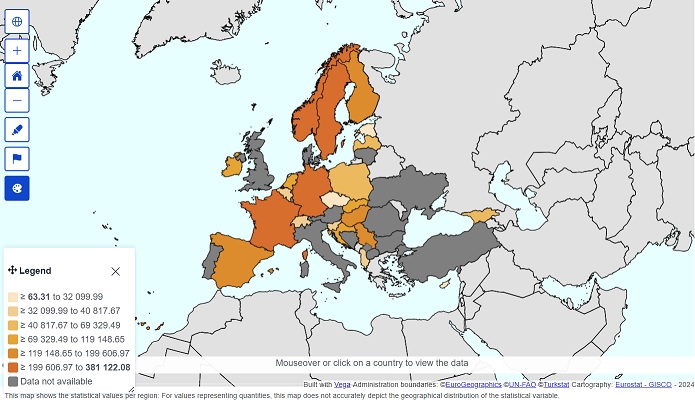
Figure 1. Renewable freshwater resources
Source: Eurostat.
While Europe, and CEE in particular, remains far from a „Day Zero” scenario, where citizens are virtually deprived of all drinking water (with Cape Town historically having come closest only a few years ago), the risk of severe shortages or recurring consumption limits [4] cannot be dismissed. The latter is already a reality across Western Europe’s capitals and rural areas, where summer restrictions are increasingly enforced and may soon expand into the off-season norm.
The European Commission underscores an additional concern: the acute loss of groundwater, driven largely by intensive agricultural irrigation that depletes deep aquifers with sluggish replenishment rates, coupled with rising per capita water footprints. Together, these dynamics heighten scarcity, already impacting 40% of EU citizens and over one third of its territories [5]. Considering that nearly three-quarters of Europeans [6] depend on groundwater for drinking purposes, any disruption to these basins risks sparking chain reactions with wide-ranging social and economic repercussions.
Exacerbating these dynamics, drought-stricken winters and historically low precipitation, with France, for instance, recently registering 85% below-average rainfall [7] in 9 of the past 12 months, have further undermined replenishment cycles. With soils unable to absorb and retain what little water arrives, deficits climb [8], pushing water stress indicators across the region to increasingly alarming levels.
Regardless, for the time being, the situation in CEE appears somewhat more nuanced, which grants the region a degree of manoeuvrability should new policies be drafted in the coming years. On the one hand, it records the lowest water consumption values across the EU, both per capita and industry-wide, while benefiting from relatively high proven reserves, strong accessibility rates, and stable replenishment levels. On the other hand, however, it simultaneously struggles with the lowest drinking-water quality, elevated pricing levels, accelerated ice melt, and an above-average dependency on external flows.
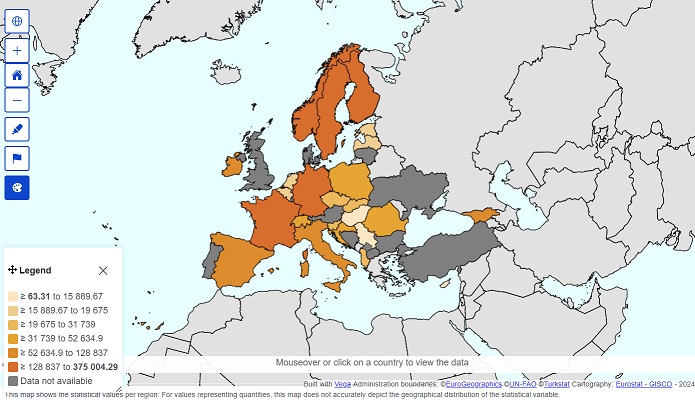
Figure 2. Internal flow
Source: Eurostat.
These water flows, both internal and external, trace the origins of a country’s freshwater, meaning that nations heavily reliant on resources beyond their borders can face multiple challenges, ranging from cascading pollution to outright disputes. While this is not yet the case, the region’s dependence on a relatively small number of large transboundary river basins, such as the Danube, Dniester, Vistula, Odra, and Neman, makes it a potential source of friction.
According to Eurostat datasets, which are based on observations from the European Space and Environment Agencies, internal flows across CEE steadily declined between 2017 and 2021, with the exceptions of Austria, Croatia, Romania, and Slovakia. The most pronounced decreases occurred in Hungary, where flows fell from 5 million cubic meters to a mere 200 thousand, and in Lithuania, which dropped from 21 million to 5 million cubic meters. Most other countries lost roughly a quarter of their internal flows over the same five-year period, yet this loss can easily accelerate in the future.
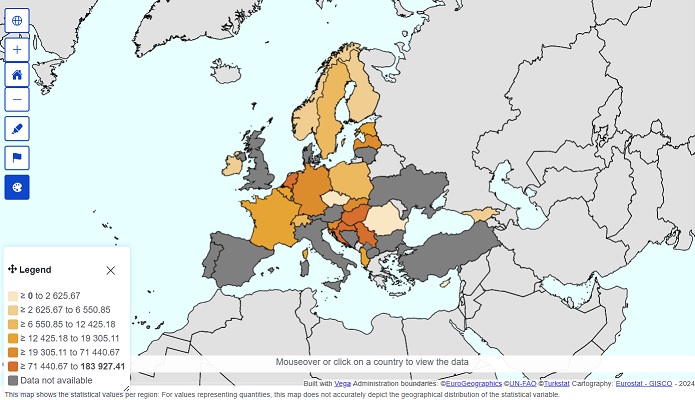
Figure 3. Actual external inflow from neighbouring countries
Source: Eurostat.
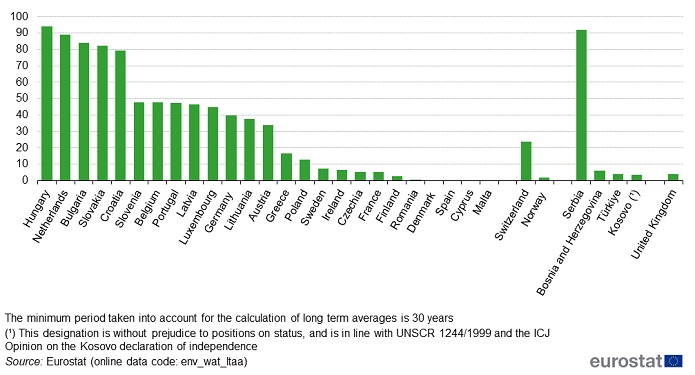
Conversely, during the same timeframe and sources, external water inflows from neighbouring countries generally increased, except in Croatia, Estonia, Latvia, and Slovakia. At the same time, the total external outflows to neighbouring countries largely decreased by about one-third, primarily due to reduced internal capacities. Like in any export/import situation, turning the balance towards outward sources can mean increased dependency and contestation, especially as it is a highly valuable, monopolistic, life-supporting good. As a result, nearly half of the region relies heavily on external sources for renewable freshwater [9]. Hungary tops the list, with over 90% of its water coming from abroad, followed closely by Bulgaria, Croatia, and Slovakia at around 80%. In contrast, Czechia and Romania are the only countries with less than 10% dependence on external sources, while the remaining CEE states hover near the 25% mark.
Figure 4. Share of external inflow from neighbouring territories in renewable freshwater resources - long-term average
Source: Eurostat.
Meanwhile, several EU-wide measures are being implemented under the Green Deal [10] umbrella, including dozens of directives, funds, and strategies, aimed at tackling cross-regional water challenges. Even so, in this new era of environmental uncertainty, Europeans must come to terms with an unprecedented reality: a significant portion of their water may originate beyond their borders, making cross-border cooperation and strategic planning more crucial than ever, with CEE still benefiting from some time left to adjust to this emergent reality.
Notes:
[1] Wall, M. (n.d.) Satellite photos show Europe’s drought is worst in 500 years. Space.com. Available at: https://www.space.com/satellite-photos-europe-drought-worst-in-500-years
[2] European Commission, Joint Research Centre (n.d.) European Drought Observatory. Available at: https://edo.jrc.ec.europa.eu/edov2/php/index.php?id=1000
[3] National Geographic (n.d.) Europe’s water crisis: Drought is getting worse. Available at: https://www.nationalgeographic.com/environment/article/europes-water-crisis-drought-worse-grace
[4] Graz University of Technology (n.d.) Satellite data prove persistent severe drought in Europe. Available at: https://www.tugraz.at/en/tu-graz/services/news-stories/media-service/singleview/article/satellitendaten-belegen-anhaltend-schwere-duerre-in-europa
[5] Graz University of Technology (n.d.) Satellite data prove persistent severe drought in Europe. Available at: https://www.tugraz.at/en/tu-graz/services/news-stories/media-service/singleview/article/satellitendaten-belegen-anhaltend-schwere-duerre-in-europa
[6] European Commission (n.d.) Groundwater. Available at: https://environment.ec.europa.eu/topics/water/groundwater_en
[7] CNN (2023) Europe faces winter drought as rivers run dry. Available at: https://edition.cnn.com/2023/02/24/europe/europe-winter-drought-rivers-climate-intl/index.html
[8] European Environment Agency (n.d.) Use of freshwater resources in Europe. Available at: https://www.eea.europa.eu/en/analysis/indicators/use-of-freshwater-resources-in-europe-1
[9] Eurostat (n.d.) Share of external inflow from neighbouring territories in renewable freshwater resources – long-term average [Image]. Available at: https://ec.europa.eu/eurostat/statistics-explained/index.php?title=File:Share_of_external_inflow_from_neighbouring_territories_in_renewable_freshwater_resources_-_long-term_average.png
[10] European Commission (n.d.) Water. Available at: https://environment.ec.europa.eu/topics/water_en