Making Sense of Speed and Turmoil in the Age of AI – China, the Middle East and the Rest Can we see through the winds of change?

“In the information age, it’s not just whose army wins, but whose story wins.”
Joseph Nye
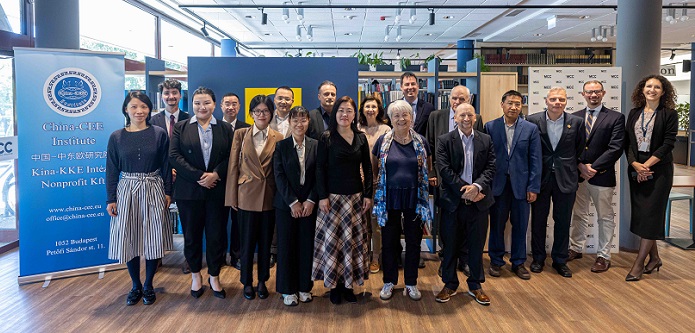
At the beginning of May I was invited to participate in an international conference in Budapest jointly organized by the Center for International Economy at Mathias Corvinus Collegium (MCC) and the China-CEE Institute. The theme of the conference was “Geopolitical Stress Test: The Middle East Crisis and Europe’s China Dilemma”. It was a good opportunity to catch up with researchers that I have met before, to revisit the MCC Campus and to prepare for an exchange of ideas on one of the hottest topics of today’s political scene.
In this article I’d like to briefly present the themes of the panels of the conference, with a focus on the one in which I was invited, to point out some of the main discussions that took place and last, but not least, to remind ourselves of the lovely, green and picturesque city of Budapest, so welcoming and cosmopolitan.
The conference was opened by Krisztián László – Director of International Relations, MCC, and Tian Huifang – Research Director, China-CEE Institute. The discussions were streamlined in four panels covering the essential points of the theme: Panel 1 – Systematic shock or managed crisis; Panel 2 – Trade Routes under Stress: The End of Cheap Globalization?; Panel 3 – Soft power of China, cultural exchanges between Europe and China; and Panel 4 – Technology competition. The Closing Remarks were given by Professor Csaba Moldicz – Head of the School of International Relations, MCC.
I was invited to participate in Panel 3 together with Professor David Pickus – American University in Vietnam, and Dragana Mitrović – Head of the Centre for Asian Studies, at the University of Belgrade. Our discussions were moderated by Professor Csaba Moldicz. This is the moment where I feel the need to do some bragging, please excuse me. With such a trending topic, Soft power of China, cultural exchanges between Europe and China, bringing up some burning issues, maybe not in the presentations themselves, but definitely in the questions from the audience, Panel 3 was one of the most interactive panels of the day. The moderator asked questions, we answered and the audience was eager asking probing questions to each of us. It could go on and on, but we had to stick to a tight agenda so we had to continue our discussions over coffee. It is my firm belief that cultural issues are both appealing and engaging and we never seem to know enough about them or about soft power which is actually tough and often disconcerting. Except in retrospect.
The complexity of today’s world manifested in the continuous crises that are disrupting global energy flows, trade corridors and financial markets, and at the same time are contributing to the increasing fragmentation of the international system was present also in the overlapping of discussions among the various panels. Soft power was one of the constant key words as was the acknowledging of the fact that today’s world is not very homogeneous no matter where we look: the USA, China, Europe or Africa.
Some of the issues raised by the various speakers:
- Although we are constantly flooded with breaking new, we don’t know what really happens on the ground whether we speak about the States or Iran or Israel.
- We rarely refer to the problems of refugees outside EU. Iran has a large number of Afghan refugees as well as a large number of Azeris who are perceived rather as an integrated and well-established ethnic group. However, less is known by the general public of Africa and its wars.
- While Europe seems to face its first war without the US, the early 2026 conflict between the US, Israel and Iran represents the first major AI war in history in which AI and autonomous systems were the main event, not just simple tools. Its defining characteristics were the strategic targeting of commercial data centers (Iranian drone attacks hit Amazon Web Services facilities in the United Arab Emirates, disrupting regional applications) and generative disinformation (deepfakes and AI-generated misinformation to manipulate international narratives).
- The paradoxes of the relations with China: EU needs China, but doesn’t know how to collaborate with it being afraid of security reasons, the UK has significant economic ties with China which is the UK’s fifth-largest trading partner and yet it is one of the strongest voices against China.
- Decoupling is not working: soft power is important and so is understanding one another’s culture. One of the Chinese speakers underlined that Hungary has an interesting connectivity strategy and is, therefore, optimistic that working together with the new government in Hungary is a good option.
- There was an interesting question asked by one of the moderators “Are we in a new cold war or in the WW3 already?”. The answers of the panelists were: cold war; neither, it’s a new beginning with multiple wars. And, finally, who knows? Multiple wars seem to be an answer to avoid massive escalation so we have to get used to them.
Next, I will try to briefly present some of the issues raised in the panel I was part of, the one focusing on the soft power of China.
We underlined again from our diverse experiences the difficulties of making sense of the 21st century with its increasing velocity – of technological change, geopolitical shifts, and social transformation. The role of AI for this acceleration was again mentioned with its consequences of time compression and often unpredictable consequences on political decisions.
My contributions to the panel were organized around the argument that the “change” in the AI age is not merely technological but civilizational: it reshapes soft power, redefines alliances, and blurs the line between stability and disruption. I talked about soft power and underlined one of the essential aspects for possible ways forward – the need for improved and authentic education at all levels. Education seemed to be a soft spot for all those present which was understandable considering we were from the industry.
One of the most intriguing developments in recent years is the emergence of “Chinamaxxing” – a social media trend in which individuals, particularly in the West, adopt elements of Chinese culture. This phenomenon has sparked a debate about whether China’s soft power is rising.
However, the nature of mainly (young) Westerners’ fascination with Chinese history and everyday practices is contested by some analysts who argue that it represents genuine cultural influence, while others see it as superficial or ironic.
At the same time if we consider things critically, the trend may also say much about the West as it does about China. One interpretation suggests that “Chinamaxxing” is driven by dissatisfaction with Western systems – particularly healthcare and lifestyle – rather than a deep engagement with Chinese culture. In this sense, it is less a sign of China’s cultural ascendancy than of Western introspection. Which led of course to a discussion about Chinese soft power. Global indices show an improvement in China’s reputation in terms of reliability and technological capability. However, sceptics argue that political constraints limit its cultural appeal. The controlled nature of China’s media environment may hinder the kind of organic cultural production that underpins soft power.
There is a paradox: to most western eyes China’s soft power is simultaneously expanding and is constrained, shaped by both technological excellence and political limitations.
We had a thought-provoking discussion on the difference between soft power and propaganda. Not an easy topic. Briefly, soft power, as popularized by Joseph Nye, is about attraction rather than coercion. A country (or organization) influences others because its culture, values, policies, or institutions are appealing. Examples can be the global spread of Hollywood films, Korean pop culture, or universities that attract international students.
Propaganda, on the other hand, is more about deliberate, strategic persuasion, often with an immediate political goal and sometimes involving manipulation or selective truth. Classic examples include state-controlled messaging during wartime or authoritarian regimes shaping public opinion. In my opinion, which is which needs critical thinking which is built upon solid and continuous education, or what we call over here, in Europe, lifelong education.
At the end of the conference, we seemed to conclude that the age of AI is not merely an era of technological progress. It is a period of deep changes in how power is generated, exercised, and perceived. China’s rapid advancement in AI shows the possibilities of velocity, while the Middle East’s enduring instability illustrates the realities of turbulence.
These dynamics show a world in flux one in which traditional categories of power are being redefined. Soft power is no longer just cultural; it is based on user experience and technological. Geopolitics is no longer static; it is dynamic and interconnected.
In a complex world there are no simple narratives. Whose story will be stronger?
In the end, the winds of change in the AI age are both creative and destructive. They offer opportunities for innovation and cooperation, but also risks of conflict and fragmentation. Having the necessary abilities to understand these dynamics is essential for navigating an uncertain future.
I cannot, however, finish this brief account of a good – and, for some of us, memorable – event without mentioning the lovely city of Budapest in early May.
I have visited Budapest many times, the first probably in 1965. As the cliché goes, the city has come a long way. It is an incredible pleasure simply to walk through it and become part of the flow of people: calm, unhurried, and never aggressive. Traffic is remarkably disciplined, with no honking, and most people seem relaxed, smiling, enjoying the sunshine at outdoor cafés, or having lunch – whether in luxury restaurants or at street stalls, depending on their budget.
At one point, I even came across a movie shoot featuring classic cars and elegant ladies dressed in period costume.
Of course, I know that not everything is always this “touristic.” But this was my experience.