Reduction of Reality: From Positivism to Socialism

This article is excerpted from my soon-to-be-published book, Government by Permission: From Liberty to Bondage, chapter one: “The West’s Guilty Conscience.” It continues the argument I made in “The Power of Vague Things” in an earlier issue of The Market for Ideas. What Positivism and Socialism have in common is a reduction of reality to one or two dimensions. Both exemplify what Michael Polanyi calls “rationalism in politics.” Positivism abstracts from reality by dismissing what cannot be measured with precision. Socialism prioritizes the collective and general at the expense of the individual and unique.
The methodical conquest Paul Valéry had predicted in 1897 was realized in the total mobilization of all sides in the First World War. There followed a general political and cultural run on the bank in the 1920s that culminated in the Great Depression and almost universal peacetime experiments in economic and political regimentation. In “Politics of the Mind” (1932), he remarked: “we are blind and impotent, yet armed with knowledge and power, in a world we have organized and equipped, and whose inextricable complexity we now dread.”[1]
Valéry regarded the social, judicial, and political worlds as essentially mythical – the products of “a host of more or less venerable sentiments that all oddly intermingle and combine.” Yet it was against a reductionist or positivist, ideological cast of mind – dismissive of traditions and beliefs which cannot be tested empirically and confirmed – that he directed his disdain, both then and later:
“The growth of the positivist mentality, a growth resulting, as you know, from the ever tighter organization of the world, where measurable things more and more dominate the scene, where the vagueness of vague things is more and more obvious . . . the growth, as I said, of the positivist mentality is undermining the ancient foundations of society. . . . It must be acknowledged that our ruin has been hastened by the greatest minds (Voltaire, for example). Even in the sciences the task of criticism has proved singularly necessary and fruitful. The greatest minds are always skeptical minds. Yet they do believe in something; they believe in whatever makes them greater.”[2]
What perhaps troubled Valéry the most was the arrogant irresponsibility that substituted a shallow, manipulative, technocratic model of social engineering for the shared values, beliefs, and trust – the “social capital” – which bind society into functioning communities. As Francis Fukuyama later summarized in Trust (1995):
“While governments can enact policies that have the effect of depleting social capital, they have great difficulties understanding how to build it up again. . . . If the institutions of democracy and capitalism are to work properly, they must coexist with certain premodern cultural habits that ensure their proper functioning. Law, contract, and economic rationality provide a necessary but not sufficient basis for both the stability and prosperity of postindustrial societies; they must be leavened with reciprocity, moral obligation, duty toward community, and trust, which are based on habit rather than rational calculation. The latter are not anachronisms but rather the sine qua non of the [former’s] success.”[3]
Still later, Valéry saw that the “increasingly thorough and effective exploitation of natural energies” stimulated an appetite for excess that creates new needs. The increasing pace of work and change, the loss of inner leisure, and the dulling of people’s sensibility were evidenced, he believed, “by our growing general indifference to ugliness and brutal sights.”
“In our present state of industrial civilization, it is as though having invented some substance, we should also, on the basis of its properties, invent an illness to be cured by it, a thirst to be appeased, a pain to be killed. So, for purposes of gain, we are inoculated with tastes and desires that have no roots in our deep physiological life but rather result from psychic or sensory stimuli deliberately inflicted. Modern man is drunk on waste. . . . All contemporary life is inseparable from these excesses. Our organism, subjected more and more to constantly new physical and chemical experiments, reacts to the forces and rhythms inflicted on it almost as it would to an insidious poison. It gets used to its poison, and soon craves it. Every day it finds the dose too little.”[4]
Such urgency is a form of conditioning, arousing desires that bear us along toward a state of things “whose complexity, instability, and inherent disorder bewilder us, allowing us not the least foresight, taking away our ability to reason about the future. . . . All this necessarily reacts on the mind itself.” Valéry recognized the political character of modern education. Instead of a character-forming and civilizing emphasis, educational programs and disciplines were designed to instill conformity. “Freedom of the mind is strictly subordinated to State doctrine. . . The State shapes men to its own ends.” He regarded “the exaggerated mania for regulations” as “a symptom of degeneration in our sense of responsibility.”[5]
A similar disdain toward the general electorate informed the Progressive movement in America. The journalist Walter Lippmann, the public relations specialist Edward Bernays, and the political scientist Harold Lasswell were prominent among those who showed how consent can be manufactured through the manipulation of public opinion. In 1969 the political theorist Sheldon Wolin critiqued the behaviorist school of American political science, a form of positivism, which was represented by Lasswell among many others:
“A wide variety of theories [now] exists for the political scientist to choose from. To call them political theories [in the behavioral manner] is, in the language of philosophy, to commit something like a category mistake. Systems theories, communications theories, and structural-functional theories are unpolitical theories. . . . They offer us no significant choice or critical analysis of the quality, direction, or fate of public life.”[6]
The transmission of knowledge
Another critic of positivism, the chemist and philosopher Michael Polanyi, paid homage to traditional crafts and skills as he pursued practical responses to the larger cultural crisis in a series of books. He believed the transmission of “indwelling” knowledge – a heritage – from one person to another, and one generation to another “must be predominantly tacit” and accepted on faith. “In order to share this indwelling, the pupil must presume that a teaching which appears meaningless to start with has in fact a meaning which can be discovered by hitting on the same kind of indwelling as the teacher is practicing. Such an effort is based on accepting the teacher’s authority.”[7]
Echoing a familiar Gospel passage about being humble and teachable like a child (Mark 9:36-37), Polanyi remarks in The Tacit Dimension:
“Think of the amazing deployment of the infant mind. It is spurred by a blaze of confidence, surmising the hidden meaning of speech and adult behavior. This is how it grasps their meaning. And each new step can be achieved only by entrusting oneself to this extent to a teacher or leader. St. Augustine observed this, when he taught: ‘Unless you believe, you shall not understand.’”[8]
Authority is personal and carries the presumption of virtue or skill. It can also provide a safeguard or resistance against the state-compelled conformity of which Valéry complained. Yves Simon defined it as “an active power, residing in a person and exercised through a command, that is through a practical judgment to be taken as a rule of conduct to the free-will of another person.”[9] To use the mimetic language of René Girard, authority resides in a person who originates or models something desirable and worthy of emulation, much as the Apostle Paul recommended in Philippians 3:17.
By contrast, the idea of man implied by modern politics is fragmented by a wide array of rival models and ideologies. An early critique of the field of political science by a respected practitioner – Floyd Matson’s The Broken Image (1964) – effectively dismantles the mechanical model of man and society which still prevails. In fact, Matson concluded the first part of his study by citing Michael Polanyi’s analysis, which culminates in a summons to greatness – that is, to a vocation which requires “personal judgment involving responsibility; self-compulsion and independence of conscience; universal standards.”[10]
Polanyi detected a source of reductionist thinking in the instability of Europe’s liberal revolutions of 1848:
“The background of 1848 was the French Revolution, which had challenged an immemorial static order by proclaiming the right of society to perfect itself according to reason, and the liberalism of the nineteenth century fought for this aim and against this order. But when the appetitive conception of man denied the reality of moral motives in public life, the ideals of liberalism were inverted into the doctrines of modern totalitarianism. Liberalism had then to fight its way back to a position which had proved disastrously unstable in the light of modern philosophies.”[11]
To some degree, traditional social institutions still regulate public mores, but, being manifestly imperfect, they also make easy targets for cultural revolutionaries. “Unjust privileges prevailing in a free society can be reduced only by carefully graded stages; those who would demolish them overnight would erect greater injustices in their place. An absolute moral renewal of society can be attempted only by an absolute power which must inevitably destroy the moral life of man.”[12] Polanyi acknowledged that “this truth is unpalatable to our conscience.” Rather than recoiling from the existing institutional framework, however, Polanyi recommended we draw an analogy between tolerating doubtful beliefs and paying “allegiance to a manifestly imperfect society, based on the acknowledgment that our duty lies in the service of ideals which we cannot possibly achieve.” [13] By contrast, the ideologue is averse to accept as genuine or sincere whoever or whatever is judged guilty by association.
Specialized intellectual passions such as scientific research “can survive only with the support of a society which respects the values affirmed by these passions.” Individual members of society may vary greatly in their level of interest, but “a society has a cultural life only to the extent to which it acknowledges and fulfills the obligation to lend its support to the cultivation of these passions.”[14] Imposing an ideological litmus test on society would cause both liberty and humanity to wither in its deadly embrace.
Polanyi recalls us instead to the foundational precepts of western civilization – to what properly belongs to human nature:
“[Man] is strong, noble and wonderful so long as he fears the voices of his firmament; but he dissolves their power over himself and his own powers gained through obeying them, if he turns back and examines what he respects in a detached manner. Then law is no more than what the courts will decide, art but an emollient of the nerves, morality but a convention, tradition but an inertia, God but a psychological necessity. Then man dominates a world in which he himself does not exist. For with his obligations he has lost his voice and his hope, and been left behind meaningless to himself.”[15]
People’s rights of life, liberty, and property forever hinge upon personal character and political courage. It is a lesson which has been dramatized from time immemorial: from the Odyssey and Proverbs to the Declaration of Independence.
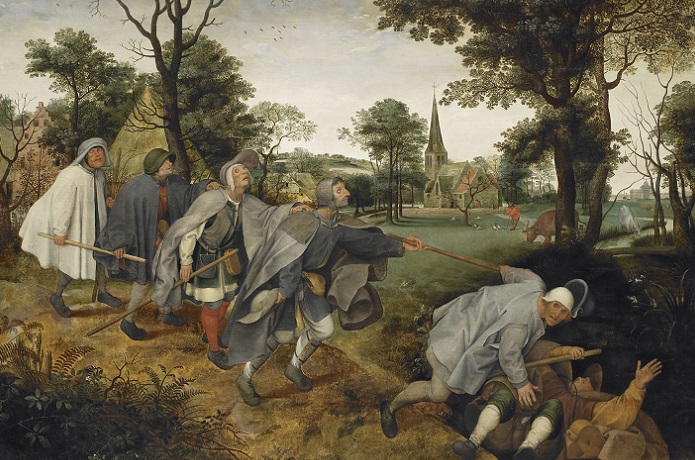
Ideological straitjackets turn citizens into subjects
The reductive, ideological mentality of mass political movements – which typically focus on mere symptoms of the breakdown of societal norms – pose a threat to life, liberty, and property that continues to intensify. Our public disputes over cultural mores have become semantic minefields where disagreements hinge on connotation and context.[16]
At the beginning of The Tacit Dimension Polanyi recounted a conversation with the soon-to-be-purged Soviet theoretician Nikolai Bukharin in Moscow in 1935. Bukharin’s contempt for scientific norms surprised him: “When I asked him about the pursuit of pure science in Soviet Russia, he said that pure science was a morbid symptom of a class society; under socialism the conception of science pursued for its own sake would disappear, for the interests of scientists would spontaneously turn to problems of the current Five-Year Plan.”[17] Polanyi added:
“I was struck by the irony that this denial of the very existence of independent scientific thought came from a socialist theory which derived its tremendous persuasive power from its claim to scientific certainty. The scientific outlook appeared to have produced a mechanical conception of man and history in which there was no place for science itself. This conception denied altogether any intrinsic power of thought and thus denied any grounds for claiming freedom of thought.”[18]
Polanyi understood what Whittaker Chambers and many other former Communists later revealed.[19] What he called “powerful moral motives” led adherents to accept an intellectual straitjacket as a token of allegiance. By paradoxically stipulating that “the mechanical course of history was to bring universal justice,”[20] the ideology conjured an atheistic proxy for the Christian doctrine of Providence that presupposed “the pre-existing harmony between scientific and social aims.”[21] Its radicalizing combination of scientific skepticism with moral perfectionism borrowed its social aspirations from Christianity even while attacking it. “Scientific skepticism would trust only material necessity for achieving universal brotherhood. Skepticism and utopianism had thus fused into a new skeptical fanaticism.”[22]
The “unscrupulous utilitarianism” – Polanyi called it “moral inversion” – exhibited by this fanatical cult of power “acknowledged no higher obligation than that of defending its own supremacy, which it must do at all costs. Those who rule in its name are entitled to scorn mercy and honesty, not simply for expediency, . . . but on account of their moral superiority over the emotionalism, hypocrisy, and general woolliness of their moralizing opponents.”[23] They exemplify what Thomas Sowell has called “the vision of the anointed.”[24]
In Science, Faith and Society (1946), Polanyi described a moral and cultural crisis that is “most sharply manifest as a menace to all intellectual freedom based on the acceptance of a universal obligation to the truth.” It arose “because the strictly limited nature of intellectual freedom had never been fully accepted by those who helped establish it” during the scientific revolution. The integrated medieval system “was replaced by a society founded on general principles interpreted by public opinion.” Truth was “to be built up on the foundations of critical reason alone.” But this unnecessary restriction proved self-destructive. “They did not recognize that freedom cannot be conceived except in terms of particular obligations of conscience, the pursuit of which it permits and prescribes. . . . Freedom of thought meant in their view the rejection of any kind of traditional beliefs, including, it would appear now, those on which freedom itself is based.“[25]
Polanyi took issue with an epistemology which leaves no place for the “tacit dimension” of traditional wisdom. Since moral questions and, by extension, a universal obligation to the truth are not “self-evident propositions,” statements of value are typically culled from the “fact” category, thus consigning them to the outer darkness of mere speculation. It is chilling to consider the implications of this attitude for the survival of the traditions of limited government by consent and the rights of citizens:
“In order that a society may be properly constituted there must be competent forces in existence to decide with ultimate power every controversial issue between two citizens. But if the citizens are dedicated to certain transcendent obligations and particularly to such general ideals as truth, justice, charity, and these are embodied in the tradition of the community to which allegiance is maintained, a great many issues between citizens, and all to some extent, can be left – and are necessarily left – for the individual consciences to decide. The moment, however, a community ceases to be dedicated through its members to transcendent ideals, it can continue to exist undisrupted only by submission to a single centre of unlimited secular power. Nor can citizens who have radically abandoned belief in spiritual realities – on the obligations to which their conscience would have been entitled and in duty bound to take a stand – raise any valid objection to being totally directed by the state. In fact their love of truth and justice turn then automatically, as I have shown, into love of state power.”[26]
Michael Oakeshott’s essay, “Rationalism in Politics,” is especially useful in helping clarify the assumptions that underlie the cultural shift which has reshaped the moral and intellectual landscape in favor of a peremptory and nihilistic moral inversion. Following Polanyi’s lead, Oakeshott distinguished two different sorts of knowledge: technical and practical. The first, technical knowledge, is “susceptible of precise formulation.” As a means of distinguishing initiates, whether into religious cults or scientific professions, its language may be deliberately esoteric. Here we meet again Valéry’s positivist: “The Rationalist holds that the only element of knowledge involved in any human activity is technical knowledge. . . . The sovereignty of ‘reason,’ for the Rationalist, means the sovereignty of technique. The heart of the matter is the pre-occupation of the Rationalist with certainty.”[27]
The second, practical knowledge, by contrast, exists only in use and requires mastery through guidance and practice. The “method by which it may be shared and becomes common knowledge is not the method of formulated doctrine.”
“And if we consider it from this point of view, it would not, I think, be misleading to to speak of it as traditional knowledge. In every activity this sort of knowledge is also involved; the mastery of any skill, the pursuit of any concrete activity is impossible without it. These two sorts of knowledge, then, distinguishable but inseparable, are the twin components of the knowledge involved in every sort of activity.”[28]
The two types differ in how they are transmitted. Technical knowledge can be both taught and learned in the simplest sense. “On the other hand, practical knowledge – whether the artistry of a pianist, the style of a chess-player, or the judgment of a scientist – can neither be taught nor learned, but only imparted and acquired.”
Rationalism in politics, like Sowell’s vision of the anointed, is characteristic of intellectuals whose thinking is formulaic and whose “cast of mind is gnostic.”[29] The ideologue attempts to divorce technical from practical knowledge in much the same way that the positivist divorces what can be verified empirically from what cannot. The result is a tendency to substitute abstractions and ideological prescriptions for practical solutions to intractable problems which may require an acceptance of the limits of technical expertise to find convivial solutions.
Oakeshott attributed the uprooting of social and moral conventions to the intellectual arrogance of the Rationalists – positivists, behaviorists, reductionists – who has “no sense of the cumulation of experience, only of the readiness of experience when it has been converted into a formula: the past is significant for him only as an encumbrance.” Oakeshott referred to this as “idolatry.” What passes for “a higher morality is merely morality reduced to a technique, to be acquired by training in an ideology rather than an education in behavior.”[30] Much of the Rationalist’s “political activity consists in bringing the social, political, legal, and institutional inheritance of his society before the tribunal of his intellect.”[31]
- S. Lewis similarly wrote in 1943 that the Enlightenment project to control nature through science has turned to remaking man, as well. [32] Wherever we turn we see indications that people are being reduced from citizens to subjects. Even Americans – having begun by seeking liberty from a distant and intrusive Parliament – now too often defer, though often mockingly, to remote, ubiquitous, self-confident images of authority projected on a screen. As Oakeshott knew: It takes practical wisdom honed by experience and a sense of history to resist beguiling ideological snares that reduce reality to a slogan or a soundbite.
Let us direct a series of historical mirrors at our common problems to help free us from certain idols of the mind, as Francis Bacon called them. As Valéry understood, we have a penchant for idolatry. Our problems are ultimately spiritual and perennial. It helps to remind us that “out of [the heart] come the issues of life” (Prov. 4:23), whether it is envy, slander, larceny, adultery, or murder – both individually and collectively.
The moral hazard of legal plunder
Following the Great Depression and the Second World War, Henry Hazlitt, the principal editorial writer on economics and finance for the New York Times from 1934 to 1946, wrote a book entitled Economics in One Lesson. The lesson is simply this: "The art of economics consists in looking not merely at the immediate but at the longer effects of any act or policy; it consists in tracing the consequences of that policy not merely for one group but for all groups.”[33] Opening the book with Frederic Bastiat’s analysis of the economic impact of a broken window, Hazlitt took aim at many of the economic fallacies – what Bastiat called economic sophisms – that have been used to justify “capricious government intervention in business.”
Bastiat was a mid-nineteenth century economist and member of the French National Assembly who brought clarity to “the dismal science.” For example, he mocked the self-absorbed pettiness of so much interest group activity in “The Candlemakers’ Petition,” a satirical proposal to block the sun’s rays in view of the harm it inflicted upon the candlemakers’ trade.[34] Equally powerful is his argument in The Law in favor of a state of social and economic self-governance.[35]
The Law begins with an expression of alarm: “The law perverted! And the police powers of the state perverted along with it!”
At the time Bastiat’s essay was published in June 1850, the Revolution of 1848 was still in the air. Idealistic abstractions and political slogans – what Jacob Burckhardt called “clear but false ideas” – were on everybody’s lips. The French monarchy fell in 1848 and Louis Napoleon was elected president. Napoleon seized power outright three years later and briefly jailed Alexis de Tocqueville, a former cabinet official who had earlier written the classic of liberal political philosophy, Democracy in America. By then, Bastiat himself had died of tuberculosis. Tocqueville, who suffered from the same disease, was forcibly retired.
The Law expresses Bastiat’s dismay that the world of political liberty had been turned upside down: “The law, I say, [is] not only turned from its proper purpose but made to follow an entirely contrary purpose! The law [has] become the weapon of every kind of greed!” The law, so to speak, had been conscripted into the service of those greedy for power. “Instead of checking crime, the law itself [is] guilty of the evils is supposed to punish!” It is the age-old problem: Who will guard the guardians?
A legal positivist makes a utilitarian argument that defines law in terms of a human sovereign’s power to control people. Bastiat instead makes a natural law argument rather than a utilitarian (or consequentialist) one: “[I]t was the fact that life, liberty, and property existed beforehand that caused men to make laws in the first place.” Here the intellectual battle lines are drawn.
“We hold from God the gift which includes all others—physical, intellectual, and moral life. . . . The Creator of life has entrusted us with the responsibility of preserving, developing, and perfecting it. In order that we may accomplish this, He has provided us with a collection of marvelous faculties. And he has put us in the midst of a variety of natural resources. By the application of our faculties to these natural resources we convert them into products, and use them. This process is necessary in order that life may run its appointed course. Life, faculties, production—in other words, individuality, liberty, property—this is man. And in spite of the cunning of artful political leaders, these three gifts from God precede all human legislation, and are superior to it.”
He defines law very practically as “the collective organization of the individual right of lawful defense.” More succinctly, it is organized justice. Its purpose is to substitute a common force for individual forces to protect God’s gifts, maintain rights, and enable justice to reign. He then adds the proposition upon which his subsequent argument rests: If no individual can lawfully use force to destroy the rights of others, then the same principle applies to the common force. He thus argues from the lesser to the greater.
When the law exceeds its proper functions, it acts in direct opposition to its own objective, thus destroying itself and annihilating justice. It places “the collective force at the disposal of the unscrupulous who wish, without risk, to exploit the person, liberty, and property of others,” converting plunder into a right and lawful defense into a crime. Greed and false philanthropy are what motivate people to do so.
Bastiat argues that humanity has a common aspiration toward self-preservation and self-development. ”[I]f everyone enjoyed the unrestricted use of his faculties and the free disposition of the fruits of his labor, social progress would be ceaseless, uninterrupted, and unfailing.” But history also bears witness to a fatal tendency of mankind: “When they can, they wish to live and prosper at the expense of others.” This covetous and rivalrous sort of desire is the first root cause: greed.
Bastiat then contrasts the origin of property with the origin of plunder. Property originates in the fact that “[m]an can live and satisfy his wants only . . . by the ceaseless application of his faculties to natural resources. . . . But it is also true,” he continues, “that a man may live and satisfy his wants by seizing and consuming the products of the labor of others. This process is the origin of plunder.” This is what one might expect the law and the sovereign state to prevent.
“When, then, does plunder stop? It stops when it becomes more painful and more dangerous than labor. It is evident, then, that the proper purpose of law is to use the power of its collective force to stop this fatal tendency to plunder instead of to work. But since the law is made by men and since law cannot operate without the sanction and support of a dominating force, this force must be entrusted to those who make the laws.”
This necessity, combined with the fatal tendency in the heart of man, “explains the almost universal perversion of the law. Thus it is easy to understand how law, instead of checking injustice, becomes the invincible weapon of injustice.” He calls the result “legal plunder.” What, in turn, further weaponizes legal plunder is “the seductive lure of socialism” to make the law “philanthropic,” demanding that “the law should directly extend welfare, education, and morality throughout the nation.” It is a means of manipulating sentiment and managing reality.
Let us now see where the logic of Bastiat’s argument impels us: “when plunder is organized by law for the profit of those who make the law, all the plundered classes seek to enter into the making of laws.” Why? Either to stop the plunder, or to share in it. As socialism’s coercive “philanthropy” becomes more widespread, “men seek to balance their conflicting interests by universal plunder.” This should be understood as a subtle way of buying off political rivals while making them complicit in the plunder. Margaret Thatcher later slyly deflated the socialists’ reputation for probity: “Socialist governments traditionally do make a financial mess. They always run out of other people's money.”[36]
Photo source: [1] Joseph Wright of Derby, A Philosopher Giving a Lecture on the Orrery (1766), Wikimedia Commons (Public Domain); [2] Pieter Bruegel the Elder, The Blind Leading the Blind (1568), Wikimedia Commons (Public Domain).
Notes:
[1]Paul Valéry, The Collected Works of Paul Valéry, vol. 10: History and Politics, ed. Jackson Mathews, Bollingen Series 45 (New York: Pantheon Books, 1962) 91.
[2]Ibid. 106.
[3]Fukuyama, Francis Fukuyama, Trust: The Social Virtues and the Creation of Prosperity (New York: Free Press, 1995) 11.
[4]Valéry, Politics 140.
[5]Ibid. 146, 144.
[6]David M. Ricci, The Tragedy of Political Science: Politics, Scholarship, and Democracy (New Haven: Yale, 1984) 149.
[7]Michael Polanyi, The Tacit Dimension (Garden City, NY: Anchor, 1967) 61.
[8]Ibid. 61. All Scripture citations are from the King James Version unless otherwise noted.
[9]Yves Simon, Nature and Functions of Authority, The Aquinas Lecture, 1940 (Milwaukee: Marquette, 1948) 6.
[10]Floyd W. Matson, The Broken Image: Man, Science and Society (Garden City, NY: Anchor, 1966) 110.
[11]Michael Polanyi, Personal Knowledge: Towards a Post-Critical Philosophy (New Yortk: Harper, 1964 [1958]), 244.
[12]Ibid. 245.
[13]Ibid. 245.
[14]Ibid. 203.
[15]Ibid. 380.
[16]See Josef Pieper, Abuse of Language, Abuse of Power (San Francisco: Ignatius Press, 1992) 32-33.
[17]Polanyi, Tacit 3.
[18]Ibid. 3-4.
[19]Whittaker Chambers, Witness (New York: Random House, 1952).
[20]Polanyi, Tacit 4.
[21]Michael Polanyi, Science, Faith and Society (Chicago: Phoenix, 1964 [1946]) 8.
[22]Ibid. 4.
[23]Polanyi, Personal 231.
[24]Thomas Sowell, The Vision of the Anointed: Self-Congratulation as a basis for Social Policy (New York: Basic Books, 1995).
[25]Polanyi, Science 74
[26]Ibid. 78-79.
[27]Michael Oakeshott, Rationalism in Politics and Other Essays (Indianapolis: LibertyPress, 1991) 15-16.
[28]Ibid. 12.
[29]Ibid. 40.
[30]Ibid. 6, 40.
[31]Ibid. 8.
[32]C. S. Lewis, The Abolition of Man, or Reflections on Education with Special Reference to the Teaching of English in the Upper Forms of Schools (New York: Macmillan, 1965) 72. Lewis later dramatized these observations in his fictional works, notably the third volume of his Space Trilogy. See C. S. Lewis, That Hideous Strength: A Modern Fairy-Tale for Grown-Ups (New York: Scribner, 2003 [1945]).
[33]Henry Hazlitt, Economics in One Lesson (New Rochelle, NY: Arlington House, 1979 [1946]) 17.
[34]http://bastiat.org/en/petition.html.
[35]The following quotations are taken from Frederic Bastiat, The Law (Irvington-on-Hudson, NY: The Foundation for Economic Education, 1998). https://fee.org/media/14951/thelaw.pdf
[36]https://www.oxfordreference.com/display/10.1093/acref/9780191826719.001.0001/q-oro-ed4-00010826