Romania, Lowest Public Expenditure on Education Among EU Member States

Romania stands out as having the lowest public expenditure on education among EU Member States, according to the latest annual survey published by Eurostat. In 2023 (the most recent year for which processed data are available), the highest level of public expenditure on education relative to gross domestic product (GDP) among EU countries was recorded in Sweden (6.8%), followed by Finland (6.3%), Belgium (6.2%) and Denmark (6.1%). Among the remaining EU countries, public expenditure on education relative to GDP generally ranged between 3.9% and 5.3%, with Romania (3.0%), Croatia (3.1%; 2022 data), Greece (3.3%), Malta (3.4%) and Hungary (3.6%) falling below this range.
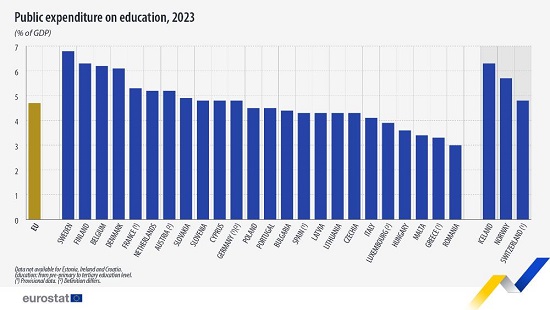
Public spending on education (from pre-primary to tertiary level) in the EU accounted for 4.7% of its gross domestic product (GDP). Compared with 2022, this figure remained unchanged; however, it represents a slight decrease of 0.3 percentage points (pp) from 2020 (5.0%), the year with the highest level of public expenditure on education since data collection began in 2012.
In more than half of the EU countries for which data are available (9 out of 16), the majority of expenditure on educational institutions in 2023 went towards teachers’ pay. However, this accounted for a lower share (40% to 50% of expenditure) in Slovakia, France, Lithuania, Czechia and Finland, while Estonia (37.6%; excluding pre-primary education) and Malta (36.9%) were just below this range.
In Greece, Hungary, the Netherlands, Slovakia, Poland, Estonia (excluding pre-primary education) and Luxembourg, capital expenditure accounted for at least 10.0% of total capital and current expenditure on educational institutions; in Germany, the share was close to this level (9.7%). By contrast, capital expenditure accounted for less than 5.0% of total capital and current expenditure in Romania and Belgium.
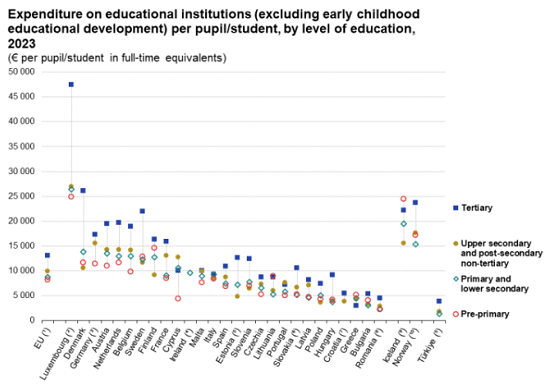
Declining birth rates and shifts in population structures have resulted in smaller school-age populations in many EU countries, and this trend is projected to continue. In turn, this may well have an impact on indicators such as average educational expenditure per pupil (for example, if expenditure is held constant). This indicator may also be influenced by other factors, such as the participation rate of young children in education.
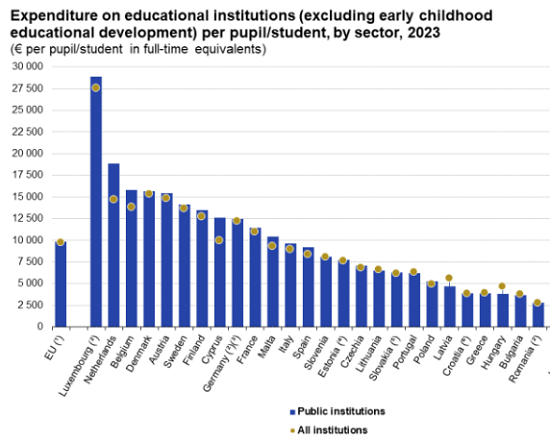
In the majority of EU countries for which comparable data are available, average expenditure per pupil/student was higher in public institutions than in all other institutions (in 20 out of 26 countries).
For most EU countries, average annual expenditure (from public and private sources) on all educational institutions per pupil/student ranged from €3,754 in Bulgaria to €15,323 in Denmark (see Figure 3). Outside this range were Luxembourg, which had considerably higher average educational expenditure per pupil/student, at €27,531, and Romania, which had a lower average, at €2,775.
All in all, it is evident that the recent surge in Romanians’ purchasing power has not translated into better public services in education. The sector remains underfunded, given the opportunities arising from a per capita GDP of 78% of the EU average, measured in purchasing power parity (PPP) terms.
Combined with the brain drain that weakens domestic businesses, despite the exceptional performance of a limited number of young students in international competitions, this represents a real threat to the country’s future development. The workforce, being one of the three factors driving a competitive economy, should be regarded as a strategic long-term investment, rather than an expense that can be cut to accommodate a relatively low ratio of government revenue to GDP.
Therefore, shifting resources within the state budget from politically convenient pension increases, aimed at securing more votes but insufficiently supported by taxes collected for this purpose, towards education, as budgetary priorities should dictate, is a must. At the very least, to keep pace with the European trend, a 50% increase in funding for teachers’ pay, facilities and equipment should be an absolute priority.
Photo source: pxhere.com.