Romania, Second-Lowest Price Level in the EU in 2025

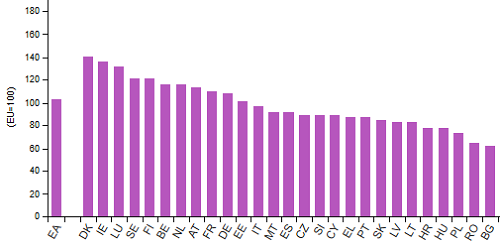
Romania had the second-lowest price level in the EU in 2025, with an index of 65.1% relative to the European average. Bulgaria ranked first, with an index of 62.5%, while Poland (73.3%), Hungary (77.5%), Croatia (78.4%), Lithuania (82.8%), Latvia (83.2%), and Slovakia (85.2%) were all above Romania.
In 2025, the highest price level for consumer goods and services among the EU Member States was observed in Denmark (40% above the EU average), while the lowest was recorded in Bulgaria (37% below the average).
Price level index for final household expenditure (HFCE), 2025
Household final consumption expenditure (HFCE) consists of the total outlay on individual goods and services by resident households, including those sold at below-market prices. HFCE also includes imputed expenditures or transactions that do not occur in monetary terms and therefore cannot be measured directly.
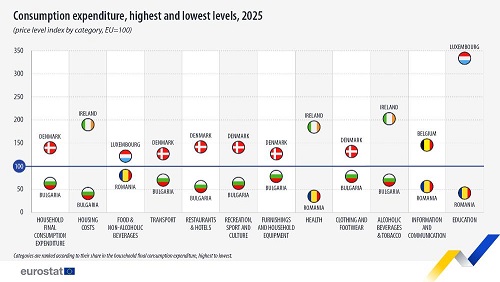
The data are drawn from the latest analysis of price levels for consumer goods and services in the European Union (EU), focusing on price level indices (PLIs), which compare countries' price levels relative to the EU average and are calculated using purchasing power parities.
Among the EU Member States, Romania is the least expensive country for food and non-alcoholic beverages (79.8%), while Bulgaria is the least expensive for the other three categories: alcoholic beverages and tobacco (69.9%), clothing (77.9%), and footwear (80.0%). Luxembourg was the most expensive EU Member State for food and non-alcoholic beverages (122.4%), Ireland for alcoholic beverages and tobacco (202.7%), while Denmark ranked first for clothing (132.4%) and footwear (127.1%) in 2025.
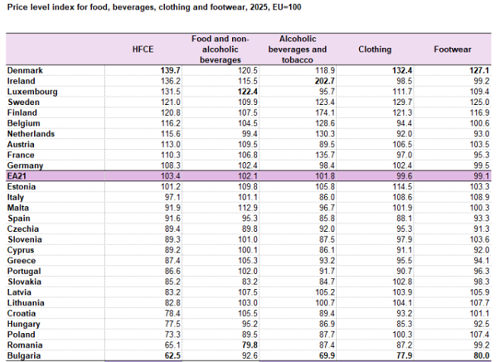
Energy prices place Romania 21st among the 27 Member States, with an index of 72%. This is relatively high compared with neighbouring Hungary (39.2%) and Bulgaria (54.2%), as well as Croatia (58.4%) and Slovakia (70.5%), but below the levels recorded in Poland (90.1%) and Czechia (102%).
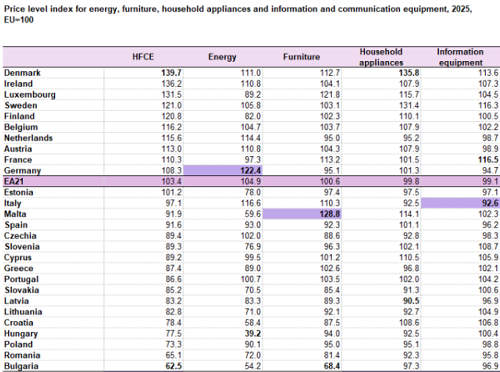
On the other hand, furniture (index of 81.4%, the second-lowest after Bulgaria at 68.4%), household appliances (92.3%, second after Latvia at 90.5%), and information and communication equipment (95.8%, after Italy at 92.6%) remain relatively inexpensive, all of them representing a significant advantage for consumers.
Only six Member States have a lower price index than Romania (93.3%) for personal transport equipment. Slovakia (88.1%), Czechia (88.7%), and Cyprus (90.4%) occupy the most affordable positions, while Denmark (119.6%), Ireland (112.6%), and the Netherlands (109.4%) are at the opposite end of the ranking.
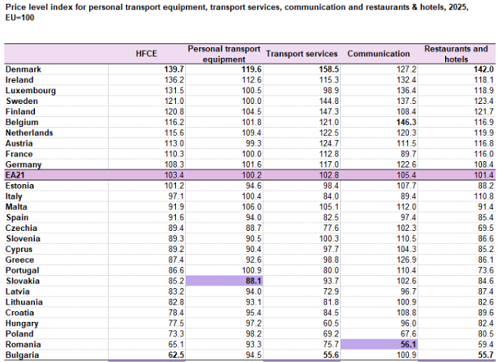
Transport services (with an index of 75.7% in Romania) are moderately more expensive than in Bulgaria (55.6%), Hungary (60.5%), and Poland (69.2%), slightly below the levels recorded in Czechia (77.6%), and well below those in Denmark (158.5%), Finland (147.3%), and Sweden (144.8%).
Communication costs are the lowest in the EU – lower than in Poland (56.1% compared with 67.6%) and substantially below those in neighbouring countries (100.9% in Bulgaria and 96.0% in Hungary). This is a major asset that should be leveraged to deliver better services, including public services, where there is considerable room for improvement.
Last but not least, restaurants and hotels remain relatively inexpensive, with the second-lowest price index after Bulgaria (59.4% compared with 55.7%). At the same time, prices are clearly lower than in Czechia (69.5%), Poland (80.5%), and Hungary (82.4%), not to mention Denmark (142.0%), Sweden (123.4%), and Finland (121.7%).
The results of this survey are expressed in the form of price level indices (PLIs). PLIs are the ratios of purchasing power parities (PPPs) to exchange rates. They provide a comparison of countries' price levels relative to the European Union average. If a country's price level index is higher than 100, it is relatively more expensive than the EU average; if it is lower than 100, it is relatively less expensive. The EU average is calculated as the weighted average of the national PLIs, with weights based on expenditure data from national accounts.
Price level indices are not intended to rank countries precisely. Rather, they provide an indication of the order of magnitude of price levels across countries, particularly when countries are clustered within a narrow range of values. In such cases, the uncertainty associated with the underlying price data and the methods used to compile PPPs may affect small differences between PLIs, resulting in ranking differences that are neither statistically nor economically significant.
All in all, these figures highlight Romania's major advantage in terms of its current price levels. This was a key factor behind the country's GDP reaching 76% of the EU average in 2022, placing Romania around 21st–22nd among the 27 Member States, alongside Hungary and ahead of Latvia, Croatia (both at 73%), Slovakia (71%), Greece (67%), and Bulgaria (67%), while approaching Poland and Portugal (79%).
That is why maintaining a firm trajectory towards lower inflation and a stable exchange rate against the euro in the coming years will be crucial for preserving living standards, while keeping public wages and social benefits – especially old-age benefits – under control and consistent with overall macroeconomic fundamentals.
Photo source: PxHere.com.