Romania, Shortest Working Life Among EU Member States

Romania has the shortest working life among EU Member States, according to data published by Eurostat for last year. With a value of 32.7 years, our country ranked last in this respect, after Italy (33.0 years) and Bulgaria (34.6 years). By contrast, in seven EU countries, the average expected duration of working life is 40 years or more: the Netherlands (44.0 years), Sweden (43.4), Denmark (42.6), Estonia (41.5), Ireland (40.7), Germany (40.2) and Finland (40.1).
Based on 2025 data, people aged 15 and over in the EU are expected to work for an average of 37.5 years, up from 37.2 in 2024. Since 2016, the expected duration of working life in the EU has increased by 2.3 years, from 35.2 to 37.5 years. Differences in the average number of years of working life between men and women were observed in all countries. In general, men are expected to work longer than women, with northern European countries showing a gender gap below the EU average of 4.1 years.
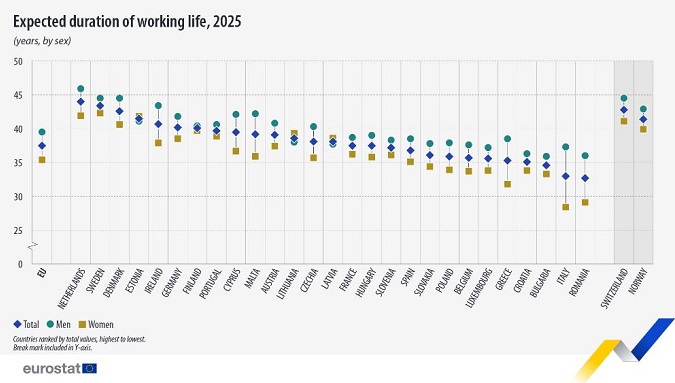
Lithuania, Latvia and Estonia were the only EU countries where the gender gap was negative, as women are expected to work there for 1.3 years, 0.9 years and 0.7 years longer than men, respectively. Among the other countries, the smallest gender gap was recorded in Finland, at only 0.7 years. At the opposite end of the spectrum, the countries with the largest gender gaps in 2025 were Italy (8.9 years), Romania (6.9 years), Greece (6.7 years) and Malta (6.3 years).
When comparing EU countries, we find that men are likely to work the longest in the Netherlands (45.9 years), Denmark and Sweden (both 44.5 years), Ireland (43.4 years), Malta (42.2 years) and Cyprus (42.1 years). Conversely, the countries where men are likely to work the least are Bulgaria (35.9 years), Romania (36.0 years), Croatia (36.3 years) and Luxembourg (37.2 years).
At the same time, the EU countries where women are likely to work for less than 30 years over their lifetimes are Italy (28.4 years) and Romania (29.1 years). These are followed by Greece (31.8 years), Bulgaria (33.3 years) and Belgium (33.7 years). By contrast, the longest durations of working life for women, i.e. more than 39 years, were recorded in Sweden (42.3 years), the Netherlands (41.9 years), Estonia (41.8 years), Denmark (40.6 years), Finland (39.7 years) and Lithuania (39.3 years).
Therefore, one can observe that our country ranks second among those with the shortest periods of activity for both sexes, while simultaneously recording the second-largest gender gap in this respect, at almost seven years. This indicates the directions to follow: an increase in the active period for men, accompanied by a significant decrease in the gender gap.
Between 2016 and 2025, the expected duration of working life increased in all EU countries (see Figure). Four countries, in particular, experienced a significant increase of 4 years or more: Malta (4.9 years), Hungary and Ireland (both 4.2 years), and the Netherlands (4.1 years).
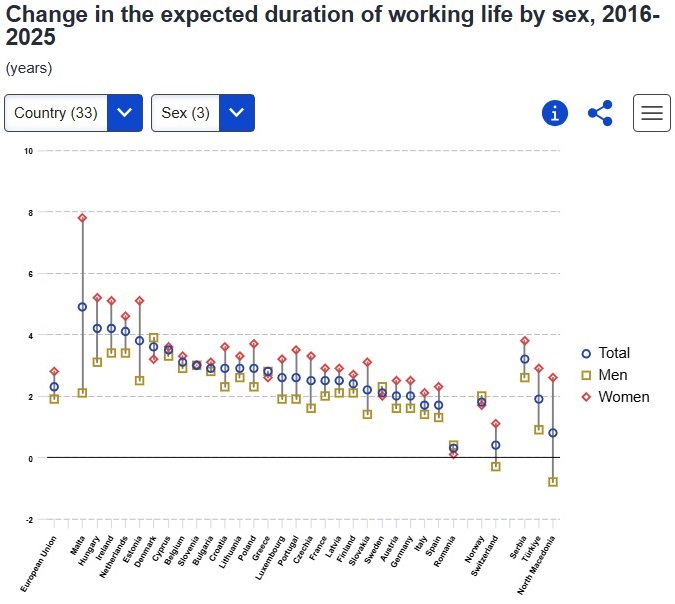
By contrast, Romania clearly lagged behind Spain, Italy, Germany and Austria, countries that experienced relatively stable expected durations of working life, with increases equal to or less than 2 years (only 0.3 years in our case, with a modest 0.4 years for men and a marginal 0.1 years for women).
Malta and Hungary, which had below-average expected durations of working life in 2016, saw sharp increases that brought them above the EU average in 2025. The main reason for Malta’s exceptional growth in the expected duration of working life was the significant increase in expected working life among women (7.8 years), the largest gain in any EU country.
A notable trend in most EU countries was that the duration of women’s working life increased more than that of men, the exceptions being Denmark, Romania, Sweden and Greece. In Malta, Estonia and Hungary, the increase was indeed substantially higher for women than for men. In Slovenia, Cyprus, Bulgaria and Belgium, the increases for men and women were roughly the same.
So, there are some aspects of our social life that need drastic improvement in order to look more like those of a European country, such as the labour market. This requires a serious process of convergence, perhaps even an accelerated one, as in Hungary, for example. So, instead of bringing in more and more foreign workers, perhaps we should take a closer look in our own backyard.
Methodological notes. Expected duration of working life is an indicator that estimates the average number of years a person aged 15 is expected to remain in the labour force (either employed or unemployed) under current conditions. The indicator does not reflect legal retirement ages, policy targets, or any prescriptive measure of how long people must or should work. Instead, it describes observed labour market participation patterns. It is calculated using life expectancy and age-specific labour force participation rates, where the labour force includes both employed and unemployed persons.
Photo source: PxHere.com.