Romania, the Leading EU Country in Overcrowding Rates for Young People

In 2025, Romania had the highest overcrowding rate in the EU among young people aged 15–29. At 60.4%, it ranked above Latvia (54.9%) and Bulgaria (52.8%), considerably exceeding the European average (26.9%, 0.4 percentage points higher than in 2024). In the EU, the overcrowding rate for young people was 10.1 percentage points (pp) higher than that for the total population (16.8%).
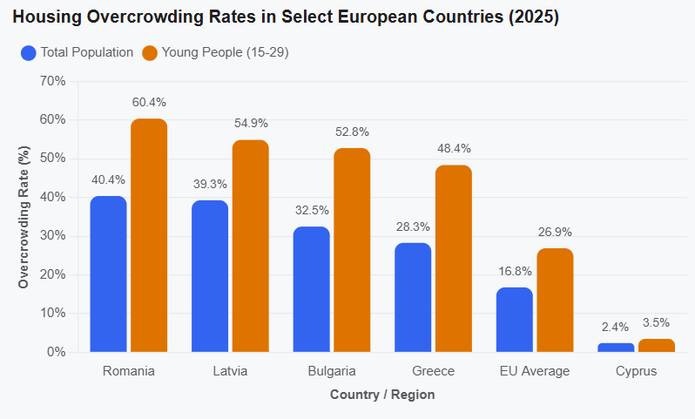
The largest differences between the overcrowding rate for young people and that for the total population were recorded in Bulgaria (20.3 pp), Greece (20.1 pp) and Romania (20.0 pp). In relative terms, the differences were greatest in Denmark and the Netherlands, where young people were more than twice as likely to live in an overcrowded dwelling as the total population; in Finland, they were almost twice as likely. Figure 2 shows the overcrowding rate for young people broken down into narrower age groups (15–19, 20–24 and 25–29 years).
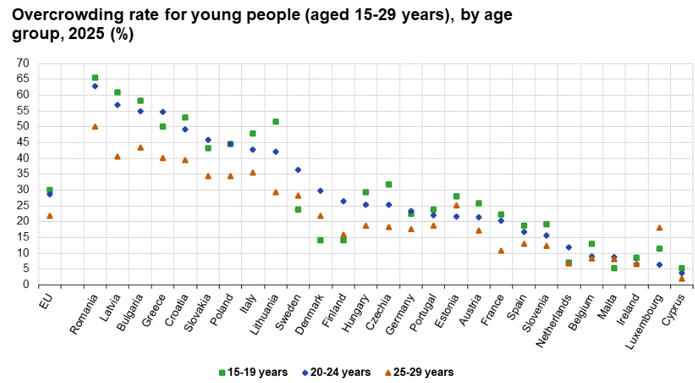
In general, in countries where the overcrowding rate for young people is high, those aged 15–19 are the most affected. In Romania, Latvia, Bulgaria, Croatia, Lithuania and Greece, more than half of 15–19-year-olds lived in overcrowded households (ranging from 65.5% in Romania to 50.1% in Greece). In most countries, the overcrowding rate decreases with age.
The largest difference between 15–19-year-olds and 25–29-year-olds was recorded in Lithuania (22.3 pp), followed by Latvia (20.3 pp), Romania (15.4 pp) and Bulgaria (14.7 pp). By contrast, in Denmark, Sweden, Finland, Greece, Malta, Slovakia, Germany and the Netherlands, overcrowding rates were highest among 20–24-year-olds.
- The Age Disparity: Across EU Member States, younger age groups are consistently more exposed to overcrowded living conditions than the general population. In Romania, Bulgaria and Greece, this age gap reaches approximately 20 percentage points or more.
- Severe Housing Deprivation: Overcrowding is often directly associated with poor housing quality. Beyond limited living space, approximately 9.6% of Romania’s total population experiences severe housing deprivation, meaning that their overcrowded homes also have serious structural defects, insufficient natural light or a lack of indoor plumbing.
The difference between this age group and those aged 15–19 was 15.7 pp in Denmark, 12.5 pp in Sweden and 12.4 pp in Finland. In other countries with lower overcrowding rates, differences between age groups were generally smaller.
In the European Pillar of Social Rights Action Plan, one of the headline targets is to lift at least 15 million people out of the risk of poverty and social exclusion by 2030. For each target, a set of indicators was developed to monitor and support the strategy. Housing conditions are included among the indicators related to material deprivation. Housing issues are also addressed in the EU Youth Strategy adopted for 2019–2027.
In 2025, there were 73.8 million people aged between 15 and 29 in the EU, and, as in many other areas of life, they can face housing challenges. Housing conditions are a key element of living standards and social integration. For young people starting life away from the family home, finding and maintaining suitable accommodation can be a major challenge.
Thus, young Romanians are disadvantaged when it comes to living conditions, which affects their quality of life and opportunities to study in an overcrowded home. Although the age at which people leave their parental home is similar to that in other countries in the region (27.4 years, compared with 27.3 in Hungary and 27.9 in Bulgaria) and lower than in Greece or Slovakia (both at 30.2 years), the problem remains and should be better addressed through social policies.
It is somewhat surprising that Romania ranks last among EU countries in so many social areas, given the progress made in terms of GDP per inhabitant, where we rank around 20th among the 27 Member States. Being in a particularly unfavourable position when it comes to studying and starting a family is a recipe for lower incomes and fewer children, which will affect the entire Romanian population in the long run, including older people who enjoy better living conditions.
Methodological Note
According to Eurostat’s definition of overcrowding, a household is considered overcrowded if it lacks a minimum number of rooms based on its size and family structure:
- One room for the whole household;
- One room per couple;
- One room for each single person aged 18 or older;
- One room for each pair of single young people aged 12 to 17 of the same gender;
- One room for any other single person aged 12 to 17;
- One room for each pair of children under 12.
Photo source: pixabay.com.