Romania, Third Among EU Members Regarding the Risk of Poverty or Social Exclusion

In 2025, the highest share of people at risk of poverty or social exclusion among European Union member states was recorded in Bulgaria (29.0%), followed by Greece (27.5%) and Romania (27.4%), according to data published by Eurostat.
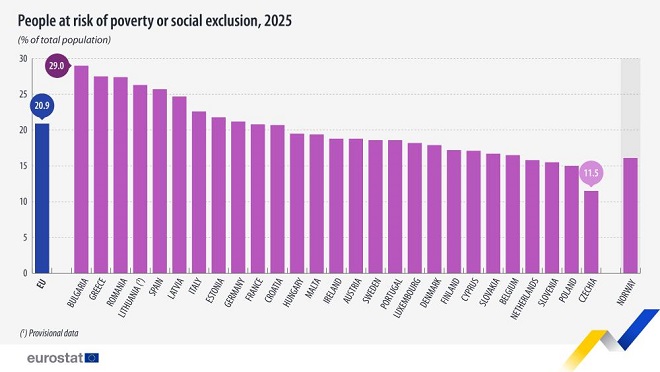
In total, 92.7 million people in the EU (20.9% of the population) were at risk of poverty or social exclusion. These people lived in households experiencing at least one of three poverty and social exclusion risks: risk of poverty, severe material and social deprivation, and living in a household with very low work intensity.
Compared with 2024, the number of people at risk decreased by 600,000 persons (from 93.3 million, or 21.0% of the population), a smaller reduction than in the previous year (in 2024, compared with 2023, there was a decrease of 0.3 percentage points, or 1.3 million people, from 21.3% of the population, or 94.6 million people).
Romania switched places with Greece after an opposite evolution, as it recorded a percentage of 27.9% in 2024, compared with 26.9% in Greece’s case. On the other hand, the lowest shares were recorded in Czechia (11.3%), Slovenia (14.4%), the Netherlands (15.4%), Poland (16.0%), and Ireland (16.7%).
This should raise concerns among decision-makers, because the relatively new welfare gains are distributed very unevenly, and this is bad news for social cohesion, as recent political events have shown. If we take into account the millions of Romanians who have already left the country, the situation could have been even worse than the figures recorded for residents indicate.
The risk of poverty or social exclusion (AROPE) is not strictly dependent on a household’s composition and income level, as it may also reflect joblessness, low work intensity, employment status, or a range of other socio-economic characteristics. To calculate the number or share of people who are at risk of poverty or social exclusion, three separate measures are combined, covering those who are in at least one of these three situations:
- people who are at risk of poverty, in other words, with an equivalised disposable income below the at-risk-of-poverty threshold;
- people who suffer from severe material and social deprivation, meaning those who cannot afford at least 7 out of 13 deprivation items (6 related to the individual and 7 related to the household) considered by most people to be desirable or even necessary for an adequate quality of life;
- people (aged less than 65 years) living in a household with very low work intensity, meaning those living in households where adults worked for 20% or less of their total combined work-time potential during the previous twelve months.
More than one-fifth (22.1%) of people living in households with dependent children in the EU were at risk of poverty or social exclusion, a share slightly higher than the corresponding rate among households without dependent children (19.8%). Nevertheless, these rates varied considerably across EU countries.
For people living in households with dependent children, the rate ranged from peaks of 29.9% in Spain, 29.4% in Romania, and 29.1% in Bulgaria, down to 12.2% in Cyprus, 11.7% in the Netherlands, and 10.4% in Slovenia (see Figure). For those living in households without dependent children, the rates varied from 33.4% in Latvia, 32.3% in Lithuania, and 28.9% in Bulgaria to 12.8% in Luxembourg, 12.3% in Slovakia, and 9.6% in Czechia.
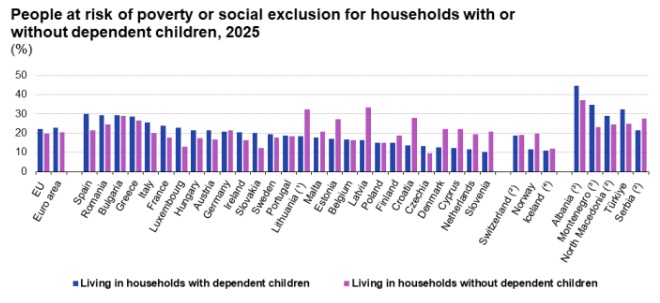
As one can see, Romania follows the Latin pattern (Spain, Italy, and France), as well as the Balkan pattern (see Bulgaria and Greece), of significantly increasing the risk of poverty when raising children. This stands in contrast to the situation encountered in all Baltic states, Finland, the Netherlands, and Denmark, but also in Czechia and Poland. The simple explanation is that the first cluster of countries tends to favour the elderly, while the latter concentrates social protection resources on younger generations.
In this context, there are two main directions for improving the situation. First, reducing poverty by redesigning the taxation system in favour of disadvantaged categories in general. Second, shifting the focus of social protection away from old-age benefits in order to achieve a more balanced approach toward raising children and offering them better development opportunities.
Photo source: PxHere.com.