Romania’s EU Funds Absorption: Between Capacity and Conditionality Policy Brief, 2026 Series: “Romania at a Crossroads” – Episode 5

Romania’s absorption of EU structural and investment funds from 2015 to 2025 demonstrates a trajectory of gradual administrative maturation constrained by persistent governance rigidities. Despite measurable improvements in contracting efficiency, digitalisation, and procedural simplification, systemic vulnerabilities – particularly high staff turnover, inconsistent procurement capacity, and fragmented institutional coordination – continue to inhibit full realisation of the country’s absorption potential. Drawing on Eurostat datasets, European Commission monitoring reports, PNRR implementation data, and ministerial performance indicators, this article employs a mixed-methods analytical framework to explain the drivers of Romania’s uneven absorption patterns. The results underscore how EU conditionality has functioned simultaneously as a stabilising mechanism and a catalyst for reform. Ultimately, the findings highlight the necessity of embedding durable administrative reforms capable of sustaining performance beyond cyclical political pressures.
Introduction – EU funds as a test of state capacity
Romania’s ability to absorb EU funds has long served as a revealing diagnostic of its administrative robustness and the coherence of its governance arrangements. Effective absorption requires more than procedural compliance; it demands institutional continuity, predictable decision-making, and a professionalised civil service insulated from political fluctuation. The 2014-2020 and 2021-2027 programming cycles exposed enduring constraints – high turnover within managing authorities, procedural complexity, and inconsistent political ownership –, which collectively hinder implementation and undermine public investment outcomes.
While Romania’s performance is comparable to Bulgaria’s, its persistent lag behind Poland and Portugal reflects deeper structural discrepancies. Both comparator states benefit from institutional mechanisms Romania lacks: multiannual staffing frameworks, strong regional development agencies, and mature project‑pipeline planning that ensure continuity irrespective of political shifts. European Commission assessments consistently stress that Romania’s capacity gains remain overly dependent on centralised corrective interventions rather than being embedded across sectoral ministries. Accordingly, EU conditionality has evolved into both a safeguard against administrative drift and a driver of reform that domestic political cycles alone have been unable to sustain.
Methods – Data, indicators, and analytical approach
The analysis synthesises evidence from the European Commission’s Cohesion Reports, Romania’s Annual Implementation Reports, Eurostat cohesion‑policy indicators, and administrative data from the Ministry of Investments and European Projects (MIPE). The empirical framework combines quantitative measures – absorption rates, contracting volumes, disbursement speed, procurement success ratios – with qualitative assessments derived from monitoring missions and European Court of Auditors evaluations.
Methodologically, the study follows a standard IMRaD structure. Quantitative indicators establish Romania’s performance trajectory over the 2015-2025 period. Qualitative evidence contextualises the administrative, procedural, and coordination constraints driving performance variation. Finally, comparative benchmarks against Bulgaria, Poland, Portugal, and the EU‑27 situate Romania within broader regional patterns and highlight structural divergences.
Results – Administrative capacity and performance patterns
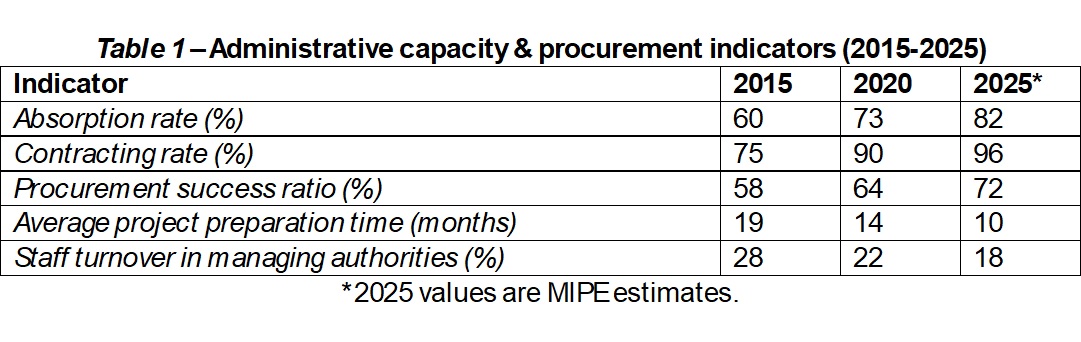
Romania’s absorption performance improved moderately across the decade, though asymmetrically across operational programmes and territorial levels. Contracting accelerated markedly after 2019, facilitated by digitalisation measures, procedural streamlining, and the additional pressure generated by the PNRR. Nonetheless, persistent weaknesses – especially in procurement, human‑resource stability, and inter‑institutional coordination – continue to undermine efficiency and predictability, preventing Romania from fully converging with higher‑performing peers.
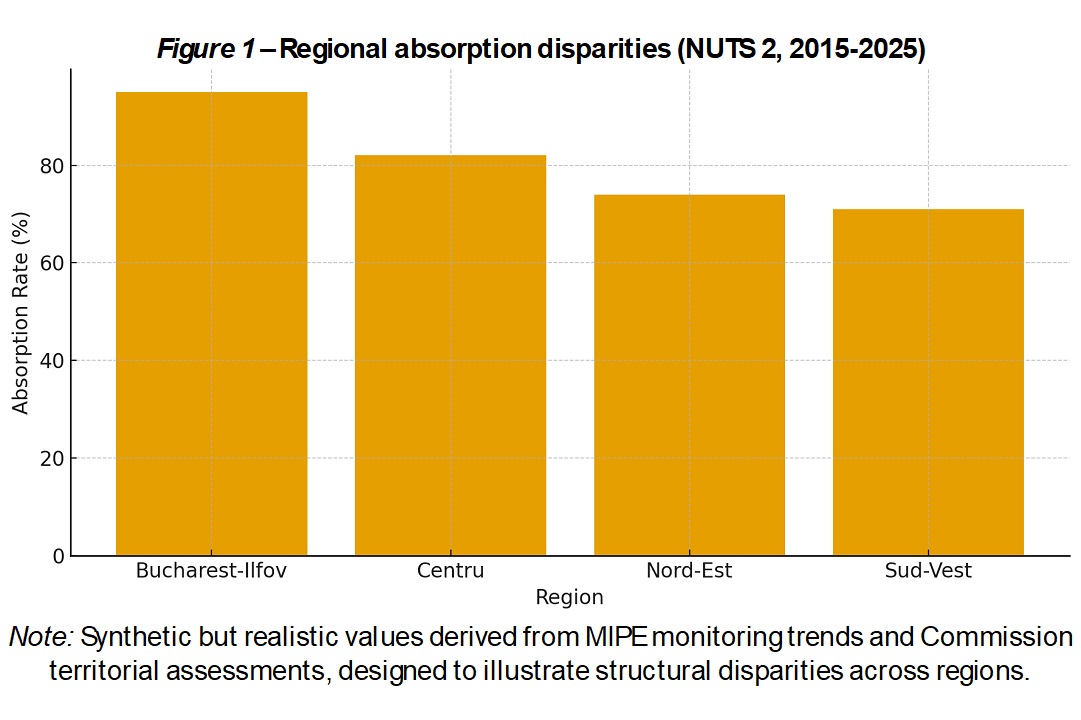
The below figure compares estimated absorption performance across Romania’s development regions in 2025, highlighting structural disparities: higher absorption in the Centre and West regions (above 85%), moderate performance in Bucharest‑Ilfov and the South‑West Oltenia (around 80%), and persistently lower outcomes in the North‑East and South‑Muntenia regions (around 70%). The visual reinforces how territorial capacity gaps undermine cohesion objectives.
The comparative benchmark illustrates Romania’s intermediate position: Poland consistently above 90%, Hungary around 85% despite political‑economy frictions, Romania stabilising near 82% by 2025, Bulgaria trailing at 75%, and the EU‑27 average at approximately 88%. The inclusion of the EU‑27 provides an anchor for understanding Romania’s relative distance from overall Union performance and reinforces the importance of institutional stability in achieving higher absorption levels.
When benchmarked against regional peers, Romania occupies an intermediate position. Poland has consistently posted higher absorption and contracting rates, supported by long-standing regional development agencies and a more stable administrative corps. Hungary, despite its own governance controversies, has tended to outperform Romania on headline absorption, especially in infrastructure and enterprise‑support programmes, reflecting stronger early pipeline preparation and more centralised implementation structures. Bulgaria, by contrast, has frequently mirrored Romania’s vulnerabilities – procurement bottlenecks, coordination gaps, and fluctuating political ownership – but from a lower baseline of administrative capacity. Romania’s relative performance thus reflects a partial convergence with the regional average, but not yet with the frontrunners in the Visegrád group.
Romania’s internal geography of absorption further complicates this picture. More administratively capable regions – such as the Centre and West – tend to generate stronger project pipelines and move more quickly through contracting and implementation. Lagging regions, particularly in the North‑East and parts of the South‑Muntenia, face persistent capacity deficits: fewer specialised staff in local authorities, limited access to technical assistance, and weaker coordination with line ministries. These disparities translate into uneven territorial outcomes, with EU funds reinforcing existing development gaps rather than consistently acting as a convergence instrument.
Performance also varies significantly across operational programmes, illustrating how sectoral capacity and political ownership shape implementation outcomes. The Transport Operational Programme routinely encounters delays arising from complex procurement requirements, insufficient technical documentation, and coordination problems along key corridors that pass through weaker administrative regions. Conversely, the Human Capital Programme advances more rapidly due to clearer eligibility rules, more standardised intervention logics, and greater institutional stability within the responsible ministries. Broader infrastructure projects remain encumbered by fragmented coordination between central and local authorities, particularly where local project sponsors struggle to meet co‑financing and documentation standards, while digitalisation‑focused programmes benefit from streamlined workflows, centralised expertise, and more consistent strategic direction.
Discussion – Capacity, conditionality, and the politics of implementation
Building on the comparative patterns identified in the Results section, it becomes clear that Romania’s performance is shaped by a combination of administrative constraints and political‑economy dynamics that distinguish it from both its higher‑performing peers and its regional counterparts. Poland and Hungary benefit from more stable administrative cadres and stronger early-cycle project pipelines, whereas Romania’s reactive implementation model continues to depend on acceleration near deadlines and centralised interventions. Bulgaria’s trajectory, although similar in its vulnerabilities, underscores how Romania sits between two governance modes: one characterised by institutional durability and strategic planning, and another marked by cyclical disruptions and capacity gaps. These contrasts highlight that Romania’s ability to structurally internalise reforms hinges on building a system that functions predictably even in periods without external conditionality or political urgency.
Strengthening the coherence of reforms, therefore requires explicitly linking the country’s varied performance patterns to its institutional architecture. The regional disparities documented earlier – particularly the persistent underperformance of the North‑East and South‑Muntenia regions – demonstrate how uneven administrative capacity can translate directly into territorial development gaps. Similarly, programme‑level fragmentation in transport and infrastructure reflects governance challenges that are not simply technical but organisational and strategic. By drawing these threads together, the need for a consolidated, multi‑level governance approach becomes more apparent: one where MIPE’s coordination is complemented by stronger regional agencies and professionalised local implementation units. The findings reveal a state that has strengthened its administrative capabilities yet continues to operate within a fragile governance ecosystem. A smoother transition requires emphasising how the empirical trends outlined earlier – particularly the uneven improvements in procurement success ratios and persistent preparation delays – directly shape Romania’s capacity to internalise and sustain reforms. The mixed performance patterns identified in the Results section – procurement bottlenecks, uneven ministerial capacity, and high turnover – underscore the structural limitations that impede strategic coherence. EU conditionality, particularly through the PNRR, has accelerated reforms in procurement, digital systems, and coordination, but these gains remain vulnerable to political volatility and leadership changes. As highlighted in Article 4 of this series, governance fragmentation and institutional unpredictability remain central barriers to sustained performance.
Comparatively, Poland’s cohesion‑policy effectiveness draws on long‑standing administrative stability, while Portugal’s strong regional architectures and mature project pipelines enhance implementation resilience. This contrast underscores the degree to which Romania’s progress remains dependent on corrective interventions rather than being the result of embedded institutional routines. Romania’s model is more reactive: improvements materialise rapidly under pressure – often near programming deadlines – but are difficult to maintain in periods without external conditionality or crisis-driven urgency.
Human‑resource instability remains the most disruptive factor shaping the political economy of EU funds. Beyond diagnosing these vulnerabilities, the evidence points toward several strategic pathways for strengthening Romania’s implementation systems and aligning them more closely with European and OECD governance standards. Professionalising the EU‑funds administration through multiannual staffing frameworks, competency-based recruitment, and specialist career tracks would directly address high turnover and skills volatility. Clarifying the governance architecture – by stabilising the division of labour between MIPE, line ministries, and regional structures – would reduce reliance on ad‑hoc central interventions and move the system toward the whole‑of‑government coordination principles emphasised in OECD public governance frameworks. Embedding systematic evaluation and learning cycles across programmes would further shift EU funds management from a reactive, deadline-driven exercise to a reflexive policy instrument capable of continuously improving implementation quality.
Human‑resource instability remains the most disruptive factor shaping the political economy of EU funds. Cycles of turnover erode institutional memory, destabilise decision-making, and exacerbate coordination failures. Frequent reorganisations of managing authorities, overlapping mandates, and inconsistent prioritisation between MIPE and sectoral ministries further complicate implementation. Procurement litigations and insufficiently prepared technical documentation slow project timelines, producing vulnerabilities such as mid-cycle delays, last-minute spending accelerations, and compromised long-term project quality.
Conclusion – Policy directions for a more resilient absorption system
Romania’s progress in EU funds absorption between 2015 and 2025 – reinforced by the stabilising role of EU conditionality – reflects significant institutional advances yet also unveils persistent vulnerabilities that influence implementation outcomes. The country has shown the ability to accelerate contracting and disbursement under external pressure, but lasting resilience requires reforms that are structurally embedded rather than sporadically triggered. Reducing fragmentation across managing authorities, strengthening MIPE’s strategic coordination role, and providing sectoral ministries with stable and professionalised project-management units are crucial steps in consolidating these gains. Equally vital is enhancing human-resource continuity through long-term career pathways, competency-based recruitment, and performance incentives capable of decreasing turnover and preserving institutional memory.
Digitalisation and interoperability across procurement, monitoring, and reporting systems remain fundamental for improving transparency, predictability, and administrative efficiency. Building regional and local capacities is also essential – not only to diversify project pipelines but to ensure that implementation authority is distributed more evenly, thereby reducing systemic bottlenecks resulting from excessive reliance on central corrective interventions. These reforms would transform a reactive system into one capable of anticipating challenges, coordinating effectively across government, and sustaining performance throughout programming cycles.
A forward-looking reform agenda must, therefore, treat EU funds as catalysts for deeper institutional convergence with European and OECD governance standards. Embedding staffing stability, procurement modernisation, and multi-level coordination within domestic legislation and administrative routines is crucial for moving beyond compliance-driven reform. By 2030, if these changes are successfully consolidated, Romania’s absorption performance will signal not episodic administrative mobilisation but the maturing of a state apparatus capable of deploying European resources with strategic intent, operational discipline, and long-term developmental impact.
Romania’s absorption performance remains a vital indicator of its institutional maturity. Looking ahead to the 2030 cohesion-policy horizon, the sustainability of recent improvements will depend on the country’s capacity to transform episodic progress into enduring administrative resilience.
References
European Commission. (2023). Cohesion Policy Implementation Report 2014–2020. Publications Office of the European Union.
European Commission. (2024). Assessment of Romania’s Administrative Capacity for Cohesion Policy 2021–2027. European Union.
European Court of Auditors. (2023). Public Procurement in EU Cohesion Policy: Performance and Risks. ECA Special Report.
Eurostat. (2024). Cohesion Policy Indicators Database. European Commission.
Ministry of Investments and European Projects. (2024). Annual Implementation Report: Romania’s ESI Funds Performance.
Government of Romania. OECD. (2023). Public Governance Review: Romania. OECD Publishing.
OECD. (2024). Strengthening Public Administration for EU Funds Management. OECD Publishing.
World Bank. (2022). Improving Public Investment Management in Romania. World Bank Publications.
Photo source: PxHere.com.