The Budget Deficit in the Last 20 Years. Some Observations

Romania has systematically recorded a negative budget execution result over the last 20 years. Essentially, the idea of the normalcy of the budget deficit has taken root, with the only discussion being about its size. In fact, in the long term, we should aim for a balance between revenues and expenditures. Otherwise, everything we accumulate at specific points, for various reasons (be it justified or not), will translate into systematic interest payments. These payments represented no less than 2.1% of GDP in 2022 (note, 70% of the space allowed by the Maastricht rule of 3%), and in 2023 they represented 1.9% of GDP, one-third of the deficit recorded in public finances.
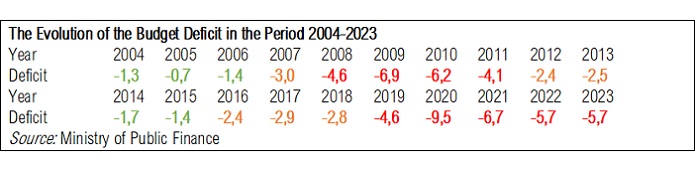
As a matter of fact, contrary to more recent results, Romania has met the specific macro-stability requirement in 11 of the last 20 years. If the period from 2008 to 2011 is mainly attributable to the global financial crisis, the series of the last five years began in the red zone, unrelated to the Covid epidemic. After that, unlike the previous temporary slip, it led to a permanent system of expenditures not matched by revenues.
Unfortunately, after 2015, when we last met the requirements for transitioning to the euro (a provision which is included in the Accession Treaty), the situation of public finances has deteriorated significantly. The lowest value of public debt in the analyzed period was in the year of accession, 2007, at 11.9% of the GDP. This was followed by a tripling of this percentage over the next decade, with a jump during the pandemic and a slow but steady growth towards the 50% limit.

It is important to note that Romania is now burdened by loans taken out and long since spent (it was only last year that the state finished repaying the infamous sum of nearly 20 billion euros taken during the 2009 crisis). Essentially, past consumption prevents us from making investments for the future. Since 2016, the paradigm has been to reduce taxation through various methods, from lowering rates to all sorts of discretionary exemptions, while simultaneously increasing public expenditures, especially through unsustainable pension increases, far outpacing the (otherwise very good) economic growth rate. Gradually restoring budget balance therefore requires increasing budget revenues and maintaining the advance of (electorally) promised benefits within the limits indicated by the projected GDP growth. Efficiently increasing revenues can be achieved, according to the effect given by last year’s collection figures, at the level of social security contributions (CAS) (around 158 billion lei) and VAT (104 billion lei).
Despite the exaggerated public attention, progressive taxation would not add much, given that income tax from salaries and earnings amounted to only 40 billion lei, and it would add to additional administration costs. Rather, capital taxation (only 28 billion lei brought to the budget), which holds the majority share of economic results (contrary to the situation in countries like Germany or France), should be considered (compensation for employees accounts for only 37% of GDP).
As for expenditures, it does not make sense to reduce the 133 billion lei for public sector employees (who, incidentally, are insufficient in number relative to the population), but to limit social welfare, which has reached 195 billion lei. This should be strictly regulated by law, within the limit of revenues collected expressly for paying pensions in the state social insurance budget. As a reference, a social security contribution (CAS) of 30% instead of 25%, a standard VAT rate of 20% with minimal exceptions of 10%, a 20% tax on dividends (thus reducing the discrepancy in amounts effectively received by beneficiaries from 77% for profits and 57% for salaries to a new figure of 67%-57%), and setting the pension point value not arbitrarily, but by dividing the budgeted amount by the total points accumulated in the system, should constitute the action lines for reducing the public deficit.
Otherwise, the Greek scenario is becoming increasingly clear, with the important difference that Romania is not in the Eurozone and corrections could be made by international markets in a much more brutal manner. These systematically incurred public deficits year after year are not just empty words we have gotten used to, as they in fact must be financed by someone or somehow. This costs us a lot in the long run and exposes us to unpleasant future shocks. It would be best to live on other people’s money to a decreasing extent, and ideally not at all.
Photo source: PxHere.