The Economics of (International) Politics An invitation to put economic reasoning to work on geopolitical realities

When Thucydides lets Pericles prepare Athens for war, the statesman's first argument is an inventory: talents in the treasury, triremes in the harbour, hoplites on the rolls. Long before economics had a name, the chroniclers of power knew that strategy begins with a budget and that every alliance hides a ledger.
The modern division of academic labour has since sent the two inquiries to different buildings. International relations went to the house of law, history and security studies; economics to the house of prices and models. Something was lost in the move. Geopolitics is still narrated in the grammar of power, interest and identity, yet its actors face the oldest constraints of economic life: scarcity, opportunity cost, imperfect knowledge, incentives that pull in different directions, institutions that make some bargains cheap and others impossible.
The question is not whether states behave like firms or households. They do not. The question is whether the instruments forged by economists – from Ricardo to Hayek, from Nash to Kahneman – can make visible what the conventional narrative leaves in the shade. The Market for Ideas has always treated economics as a way of seeing rather than a ledger of conclusions. In that spirit, we open a call for short scientific essays that put an economic theory to work on a geopolitical problem, and then put the theory itself on trial.
The invitation
We invite two-author essays of no more than two A4 pages, each testing one economic lens on one geopolitical phenomenon. The call grows out of a seminar exercise at the Faculty of International Economic Relations, Bucharest University of Economic Studies; selected essays will be published in The Market for Ideas after editorial review.
The aim is not to summarize a theory and then describe an event, but to build a reasoned causal bridge between them: to show how the theory helps explain, interpret or anticipate what states, leaders, organizations and interest groups do.
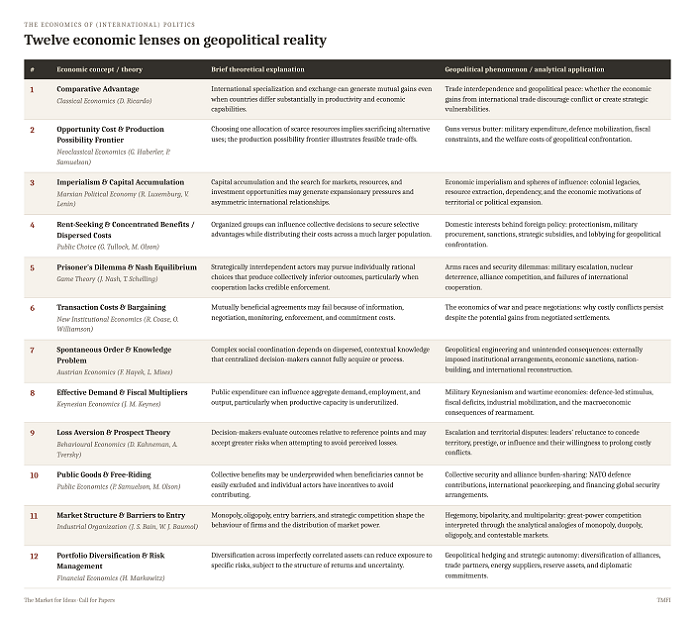
The twelve lenses below come from different traditions – classical, neoclassical, Keynesian, Austrian, institutionalist, public choice, Marxian, behavioural. They will sometimes yield divergent, even contradictory, readings of the same reality. That divergence is welcome. Such transfers are neither automatically legitimate nor universally successful: their worth depends on the clarity of the analogy, the plausibility of its assumptions, and the ability to tell a genuine causal mechanism from a merely suggestive likeness.
Twelve economic lenses on geopolitical reality
Each row pairs an economic concept with the geopolitical phenomenon it might illuminate. The phenomena in the last column are illustrations, not assignments: original, theoretically defensible applications are equally welcome.
What we expect from submissions
Suggested structure
1. Research question and theoretical framework. Introduce the economic concept, its intellectual tradition and principal contributors, and formulate a precise question about its geopolitical applicability.
2. Geopolitical application. Take a concrete historical or contemporary case and show how the theory explains the behaviour of the relevant actors, the incentives they face, the constraints under which they operate, and the outcomes of their interaction.
3. Critical assessment. Weigh the explanatory strengths and limits of the transfer. Identify assumptions that may not hold in geopolitical settings and, where relevant, consider an alternative interpretation.
4. Conclusions and predictive implications. Summarize the findings and formulate at least one conditional prediction: if theory X captures mechanism Y, then under conditions Z, outcome W should be expected.
Editorial requirements
- Length and authorship: at most two A4 pages, references included; two authors per essay, both named.
- Title: original and analytically telling, ideally joining the economic concept and the geopolitical phenomenon.
- Sources: at least three relevant academic references, including a foundational theoretical contribution where appropriate; reliable empirical sources are encouraged.
- Style: concise, coherent, argumentative and rigorous; independent reasoning rather than descriptive compilation.
- Format: Times New Roman, 12 pt, single line spacing; APA citation style (7th edition).
- Deadline: 20 December 2026.
How essays will be read
Criterion | Weight |
Accurate understanding of the economic concept | 20% |
Relevance and originality of the geopolitical application | 25% |
Quality of the causal reasoning and theoretical transfer | 25% |
Critical assessment and predictive insight | 20% |
Academic writing, structure and referencing | 10% |
Three cautions
- Pluralism with discipline. The twelve lenses mix schools of thought and specific models. Use the heterogeneity, but keep the tradition distinct from the model.
- Transfer, not analogy. Some applications are well established, others deliberately exploratory. A suggestive likeness is not yet a causal explanation.
- Conditional, not prophetic. Predictions should state the mechanism and the conditions under which they hold, not forecast the future outright.
The challenge
Brevity is part of the test. Two pages leave room only for the essential mechanism, a disciplined argument and a conclusion that explains something. The central challenge is easy to state and hard to meet: can an economic theory explain something geopolitically important that would otherwise remain insufficiently understood – and what might it lead us to expect next?
Contact author for submissions and enquiries:
Professor Octavian-Dragomir Jora, Ph.D., Founder & Editor-in-Chief, The Market for Ideas – [email protected]
We look forward to the answers.
TMFI