The Economics of (Political) Diplomacy An invitation to read diplomatic practice through economic theory

In 1939, on the eve of a war that would discredit many illusions about negotiation, Harold Nicolson set two conceptions of diplomacy side by side. The “warrior” conception treats negotiation as war by other means, a contest to be won. The “mercantile” one treats it as an exchange between parties who expect to deal with each other again. Nicolson preferred the shopkeeper. Two centuries earlier, François de Callières had already warned the negotiator that deceit is a poor investment: a reputation for good faith, once spent, is not easily bought back.
Both men were speaking, without the vocabulary, the language of economics. Behind protocol, precedence and the discreet idiom of the chancellery lie problems the economist recognizes at once: delegated authority, private information, scarce resources, incentives, institutional constraints, uncertainty. An ambassador is also an agent; a treaty, also an incomplete contract; a visa regime, also a barrier to entry; a ceremonial gesture, also a costly signal.
An earlier call in these pages, The Economics of (International) Politics, took economic reasoning to the macrostructures of geopolitics. This one descends to the microeconomics and political economy of diplomatic conduct: the mission and its mandate, the privilege and its abuse, the clause and its ambiguity, the consulate and its queue. The aim is not to reduce diplomacy to commerce, nor diplomats to profit-maximizers, but to ask what economic theory can see there that legal, historical or political description leaves unexplained.
The invitation
We invite two-author essays of no more than two A4 pages, each testing one economic lens on one diplomatic or consular mechanism. The call grows out of a seminar exercise at the Faculty of International Economic Relations, Bucharest University of Economic Studies; selected essays will be published in The Market for Ideas after editorial review.
The aim is not to reproduce textbook definitions or merely recount a diplomatic episode, but to show how economic reasoning can explain a mechanism, mark its limits, and yield conditional expectations or insights into institutional design. The most interesting essays will work precisely where legal obligations, ethical considerations, political authority and national interest resist a straightforward economic reading.
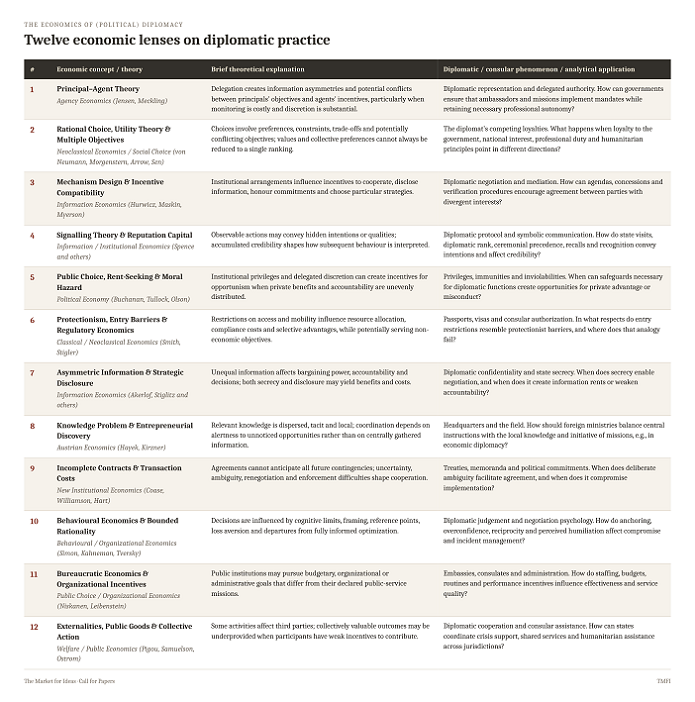
Twelve economic lenses on diplomatic practice
Each row pairs an economic concept with a diplomatic or consular phenomenon and an open question. The questions are starting points, not prescribed conclusions.
Seven reserve themes
The twelve lenses are not a closed catalogue. Authors may instead take one of these:
- Bargaining Theory & Two-Level Games (Nash, Rubinstein, Schelling; Putnam). Outside options, patience, deadlines and credible commitments; how domestic ratification constraints strengthen or weaken negotiators abroad.
- Auction Theory & Competitive Bidding (Vickrey, Milgrom). Competition for international appointments, seats, leadership positions or summit-hosting rights, and the limits of the auction analogy.
- Search & Matching Economics (Diamond, Mortensen, Pissarides; Roth). Finding and matching diplomatic, academic, cultural or investment partners.
- Hold-Up Problems & Relationship-Specific Investment (Klein, Crawford, Alchian; Williamson). The vulnerabilities of long-term bilateral arrangements and the risk of renegotiation.
- Club Theory & Membership Benefits (Buchanan). Shared diplomatic or consular facilities, reciprocal assistance and selective cooperation.
- Reciprocity, Gifts & Social Exchange (Mauss, Akerlof). Diplomatic hospitality, ceremonial gifts, reciprocal obligations, and the line between courtesy and undue influence.
- Economics of Language & Translation (Marschak, Ginsburgh). Interpretation costs, multilingual negotiation, semantic ambiguity and the drafting of diplomatic texts.
Original proposals are also welcome, provided they state a clear research question and a defensible theoretical mechanism. Originality does not exempt a proposal from analytical rigour.
What we expect from submissions
Suggested structure
1. Theoretical foundation and research question. Introduce the concept, its intellectual origins, and a precise question about diplomatic or consular practice.
2. Analytical application. Examine a concrete historical or contemporary case; identify the actors, incentives, constraints, information and causal mechanisms at work.
3. Critical discussion. Distinguish explanatory mechanisms from superficial analogies; address the relevant legal, ethical or institutional limits and, where useful, competing explanations.
4. Conclusions and implications. Offer a concise finding and at least one conditional prediction, institutional-design insight or practical implication.
Editorial requirements
- Length and authorship: at most two A4 pages, references included; two authors per essay, both named.
- Title: original and analytically telling, ideally joining the economic concept and the diplomatic phenomenon.
- Sources: at least three relevant academic references, including a foundational theoretical contribution where appropriate; reliable empirical sources are encouraged.
- Style: concise, coherent, argumentative and rigorous; a selected topic is a starting point, not a prescribed conclusion.
- Format: Times New Roman, 12 pt, single line spacing; APA citation style (7th edition).
- Deadline: 20 December 2026.
How essays will be read
Criterion | Weight |
Understanding and accurate use of the economic theory | 20% |
Relevance and originality of the diplomatic application | 25% |
Quality of causal reasoning and interdisciplinary transfer | 25% |
Critical assessment and explanatory, predictive or institutional insight | 20% |
Academic structure, writing and referencing | 10% |
The guiding question
Callières knew that a negotiator's reputation is capital; Nicolson knew that the shopkeeper outlasts the warrior. What remains is to test how far the economist's tools can carry such intuitions, and where they break. One question should guide every essay: what does the selected economic theory reveal about diplomatic practice that a conventional political, historical or legal description might leave unexplained?
Contact author for submissions and enquiries:
Professor Octavian-Dragomir Jora, Ph.D., Founder & Editor-in-Chief, The Market for Ideas – [email protected]
We look forward to the answers.
TMFI