The Romanian Paradox

In 2025, the standard at-risk-of-poverty rate in Romania fell to a record low of 18.4%, down from previous years, meaning that roughly 3.47 million Romanians had incomes below the national poverty line. Looking at the broader AROPE metric (At Risk of Poverty or Social Exclusion), which also takes severe material deprivation and low work intensity into account, Romania’s rate declined slightly to 27.4%. Despite this steady domestic improvement, Romania still has the third-highest risk of poverty or social exclusion in the European Union, behind Bulgaria (29.0%) and Greece (27.5%).
At the same time, Romania ranks second-lowest (almost the best performance) in terms of the remaining anchored poverty rate, despite ranking high in standard relative inequality. Because Romania’s real wages and pensions grew significantly faster than inflation, millions of people moved above that fixed historical threshold. This gives rise to the Romanian paradox. The striking contrast arises because the standard rate measures relative income inequality, whereas the anchored rate tracks absolute economic progress.
As Romania’s economy expanded rapidly, the national median income soared. However, economic gains were distributed unevenly. Because the lowest-income earners lagged far behind the rapidly rising national median, a large share of the population remained below this moving threshold. This makes the standard rate an indicator of substantial economic inequality.
The largest reductions in anchored at-risk-of-poverty rates were recorded in Romania (down 17.4 percentage points (pp) to 6.4%) and Bulgaria (down 15.3 pp to 7.3%). The smallest decreases were recorded in Austria (down 1.4 pp to 11.9%) and Denmark (down 1.0 pp to 11.5%). However, some countries recorded increases in their anchored at-risk-of-poverty rates. Finland saw its rate rise by 0.9 pp to 12.5%, while Germany experienced an increase of 2.1 pp, reaching 16.9% in 2025. France reported a larger rise of 3.3 pp to 16.9%.
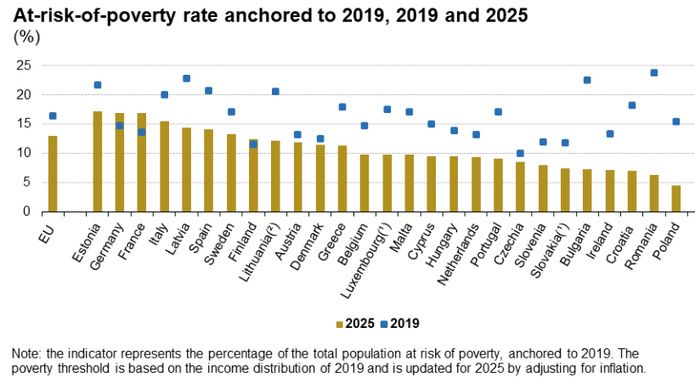
The anchored rate measures absolute improvements in purchasing power over time. It fixes the poverty threshold at a specific base year (such as 2019) and subsequently adjusts it only for price inflation. Over the last decade, Romania achieved the largest reduction in absolute poverty in the EU. Because of substantial increases in the minimum wage, pensions and labour incomes in general, the income received by low-income households rose dramatically in real terms. When assessed against a fixed historical standard (such as the 2019 threshold adjusted for inflation), the vast majority of Romanians moved above that earlier poverty threshold.
Imagine a running race in which the finish line keeps moving forward at the speed of the fastest runner. The standard rate measures how many runners fall far behind the leading group (relative distance). The anchored rate measures how many runners have passed a fixed marker on the track (absolute distance). Romania’s population is moving forward remarkably quickly compared with its earlier position, but the gap between the fastest and slowest runners remains wide.
Over the past 15 years, Romania recorded the fastest growth in median real income across the European Union, with an extraordinary 160% increase in inflation-adjusted purchasing power between 2010 and 2025, according to the Friedrich-Ebert-Stiftung. This exceptional growth rate helps explain why anchored poverty figures fell so dramatically. According to Eurostat and Social Monitor analyses, this expansion follows two distinct trajectories: nominal convergence and changes in the distribution of income among earners. While Romania’s median income stood at just 14% of the EU average in 2010, rapid wage growth pushed it to roughly 36% of the EU average by 2025.
Surprisingly, the Gini coefficient fell from 37.4 in 2015 to 27.3, below the EU average of 29.2%, according to Trading Economics. For reference, the highest income disparities among EU countries were recorded last year in Bulgaria (37.7), Latvia (35.6) and Lithuania (35.5). In Hungary (29.5), the Gini coefficient was slightly higher than the EU average. Income was more evenly distributed in Slovakia, Belgium, Czechia, Slovenia and Poland, where the Gini coefficient was below 25.0.
Therefore, the Eurostat-certified data are in stark contrast to public perceptions in Romania. This should be a crucial consideration in the economic policies to be implemented in the coming years. It must be explained that macroeconomic stabilisation is absolutely necessary and that we are now experiencing an adjustment, not an austerity programme, although it is interpreted more in terms of the French expression “manque à gagner”. This perception reflects expectations and needs rather than actual economic performance.
Methodological Note:
Standard vs. Anchored Rate: The standard at-risk-of-poverty rate uses a threshold that changes every year based on the current national median income (measuring relative low income). An anchored rate keeps the base-year threshold constant (adjusted only for price inflation using the Consumer Price Index) to track changes in absolute low-income trends over time.
Photo source: PxHere.com.